Lumail vs Ghost: Which Email Platform Fits How You Work?
Ghost is a publishing CMS with newsletters and paid memberships. Lumail is an email platform with graph workflows, transactional email, and agent access.
In this guide
Ghost is an open-source publishing platform that combines a website, paid memberships, and newsletters; Lumail is an email platform with workflows, transactional email, and AI-agent access, but no website. Pick Ghost to own a publication. Pick Lumail to operate email through agents, code, and a visual app.
Ghost is run by a non-profit foundation, takes 0% of your subscription revenue, and can be self-hosted or run on its managed Ghost(Pro) service. Lumail is built for teams whose email work runs through assistants, terminals, and product code. Ghost facts here come from its official pricing page as of August 2026 and refer to Ghost(Pro) unless noted; plans change, so check before you buy. For the compact version, see the side-by-side comparison table.
Lumail vs Ghost at a glance
| Decision | Lumail | Ghost |
|---|---|---|
| Core focus | Campaigns, workflows, transactional email, and AI agents | Publishing website with memberships, paywall, and newsletters |
| Pricing basis | Emails sent; unlimited subscribers on every plan | Registered members and staff seats; unlimited email sends |
| Free plan | 3,000 emails per month, no credit card | 14-day trial; free software if you self-host |
| Paid entry | Premium at $20/month with 40,000 emails | Starter at $15/month, billed yearly, up to 1,000 members |
| AI and developer access | 89 MCP tools, CLI, TypeScript SDK, REST API | Content and Admin APIs; beta CLI with MCP support |
| Automation | Graph workflows on every plan | Beta: two welcome flows with send and wait steps |
| Transactional email | Built in through the API or SMTP | Sign-in links and invites only; no app email |
| Best fit | Teams running email through agents, code, and a visual app | Independent publishers selling memberships on their own site |
Lumail's current plans are on the Lumail pricing page.
Choose Lumail if AI agents should operate your email
Ghost has a solid developer platform: a Content API on every plan, an Admin API and webhooks from Publisher up, and an official command-line tool, still in pre-1.0 beta, that can expose the Admin API over MCP. There is no hosted MCP server or ChatGPT app on its product pages.
Lumail exposes 89 organization-scoped MCP tools covering campaigns, subscribers, tags, segments, workflows, templates, analytics, and transactional sending. The same operations run in ChatGPT, Claude, Claude Code, and Cursor, and through a CLI, a TypeScript SDK, and a REST API. These are the product, not a developer beta.
In practice you can ask an assistant to:
- draft next week's campaign from a brief and your existing template;
- segment subscribers by tag or engagement before a targeted send;
- build an onboarding workflow with branches, goals, and exits;
- send a receipt or password reset from your product.
Choose Lumail if you need email automation beyond a welcome flow, transactional email for a product, or a bill that does not cap how many members you can store.
Choose Ghost if you want to own a publication
Ghost does something Lumail does not attempt: it runs your website. Posts, pages, themes, a member portal, a paywall, and comments all live in one open-source product.
Choose Ghost if:
- you want a custom publication website and paywall, with newsletters as one channel;
- you want 0% platform fees on paid memberships, paying for hosting instead of a revenue share;
- you want the social web, Ghost Explore, and recommendations as growth channels.
Lumail is not a website builder, has no hosted newsletter archive, and cannot be self-hosted. It provides capture pages for subscriber acquisition, and its focus is the email system itself.
Compare the pricing models, not the starting prices
Ghost(Pro) charges by registered members, free and paid alike, plus staff seats. Email sends are unlimited on every plan. If you exceed your member limit, Ghost temporarily disables publishing until you upgrade. Yearly billing is cheaper than monthly.
A few reference points, billed yearly:
- Starter: $15 a month, capped at 1,000 members, with no paid subscriptions;
- Publisher: $29 a month at 1,000 members, $88 at 10,000, $141 at 25,000;
- Business: $199 a month at 10,000 members, with more staff and newsletters.
Self-hosting Ghost is free, but you pay for your own server and for Mailgun to deliver newsletters.
Lumail charges by emails sent and never by stored subscribers:
- Free: 3,000 emails per month, no credit card;
- Premium: $20/month with 40,000 emails included, then $0.60 per 1,000;
- Business: $200/month with 400,000 emails included, then $0.40 per 1,000.
A worked example
Say you have 25,000 members and send a weekly newsletter, so about 100,000 emails a month.
On Lumail, that is Premium: $20 for the first 40,000 emails, plus 60,000 more at $0.60 per 1,000, which is $36. Total: $56 a month.
On Ghost(Pro), 25,000 members on Publisher is $141 a month billed yearly, with your website, paywall, and 0% membership fees included.
At the small end, Ghost can be cheaper. A 1,000-member list emailed weekly is about 4,000 emails, which is $20 on Lumail Premium and $15 on Ghost Starter. The fair comparison is also not only email: Ghost's price includes a website that Lumail does not provide.
Compare automation and transactional email
Ghost's native automations are a beta in its Labs settings, and once turned on they cannot be turned off. There are two flows, a welcome for new free members and one for new paid members, with send and wait steps only. You cannot create other automations yet. Beyond that, newsletters go out when you publish, and Publisher adds Zapier and n8n.
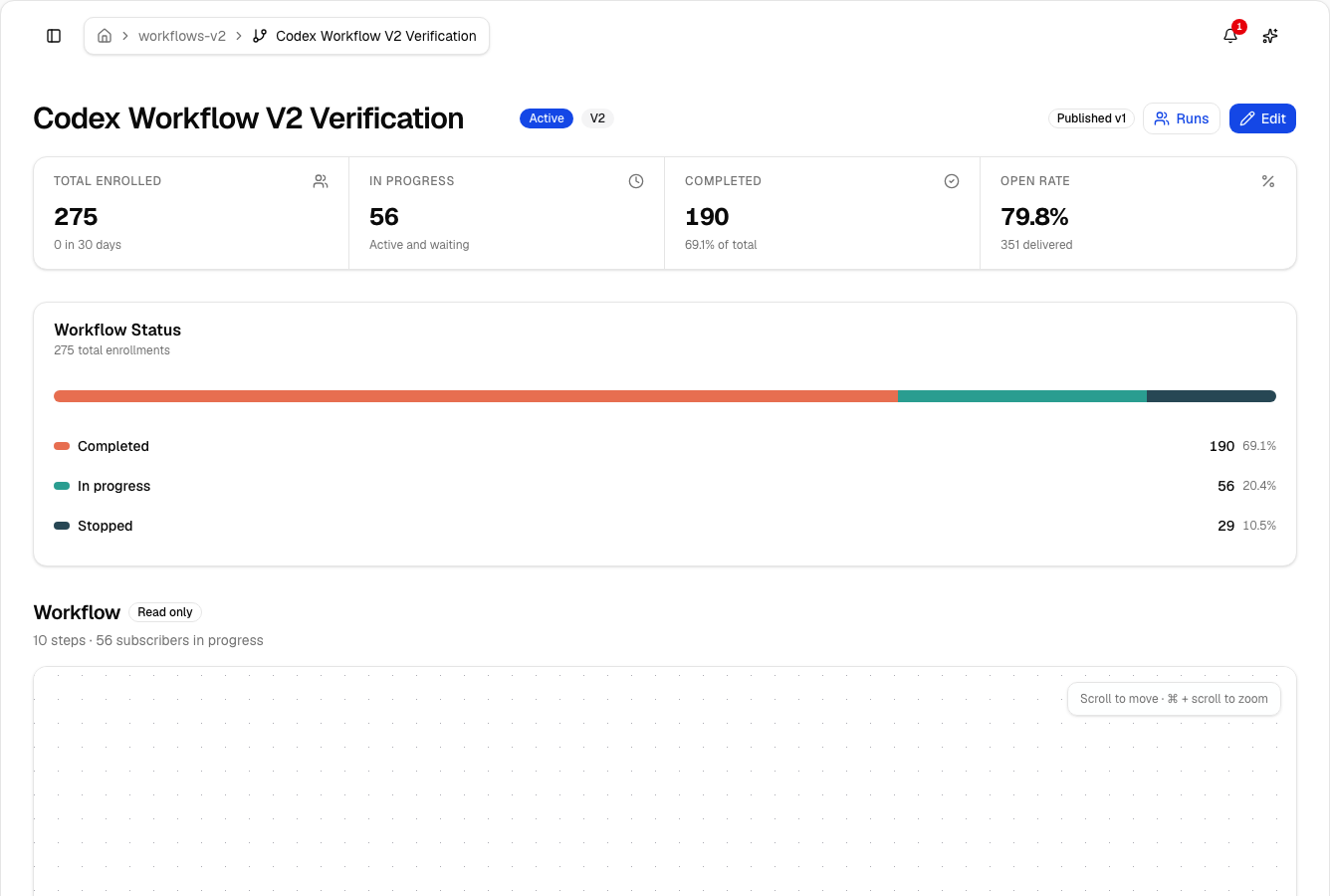
Lumail's workflow engine is graph-based and included on every plan. It supports subscriber, tag, event, schedule, and manual triggers; email, wait, action, and webhook steps; condition and weighted branches; and goals and exit rules. Agents can read and edit the same graphs through MCP, the CLI, the SDK, and the API.
Ghost's own email covers sign-in links, staff invites, and comment notifications. It has no API or SMTP relay for sending your product's receipts or password resets. Lumail sends transactional email through the REST API or smtp.lumail.io:587 with STARTTLS, in the same organization as your campaigns.
Migrating from Ghost to Lumail
Leaving Ghost for email usually means moving only the email, so plan for that first.
- Decide what stays on Ghost. Your website, paywall, comments, and Stripe memberships stay on Ghost or another platform; Lumail does not host a publication or run memberships.
- Export members. Export members as CSV and bring unsubscribed members over as suppressions, so they are never emailed again.
- Authenticate your sending domain. Set up SPF and DKIM in Lumail and verify the domain before any send.
- Rebuild welcome flows as workflows. Recreate Ghost's two welcome flows as Lumail graphs, then add the branches Ghost could not.
- Send one campaign to a small segment. Check rendering, links, and unsubscribe behavior before moving the full list.
Frequently asked questions
Is Lumail a Ghost alternative?
For email, yes. Ghost is a publishing platform with a website and paywall; Lumail is an email platform with workflows, transactional email, and 89 MCP tools. Lumail does not replace Ghost's website or memberships.
Is Lumail cheaper than Ghost?
For large lists, usually. A weekly send to 25,000 members is $56 a month on Lumail versus $141 on Ghost Publisher billed yearly. A small publication can be cheaper on Ghost, whose price also includes a website.
What is the main difference between Lumail and Ghost?
Ghost is a CMS that also sends newsletters and sells memberships, priced by member count. Lumail is an email platform priced by emails sent, with graph workflows, transactional email, and agent access, but no website.
Can I migrate from Ghost to Lumail?
Yes. Export members as CSV, import them into Lumail, and rebuild newsletters and welcome flows. Keep your website and paid memberships on Ghost or another platform.
Which one should you choose?
Choose Ghost if you are a publisher who wants an owned website, a paywall, and newsletters in one open-source product, with no cut of your membership revenue.
Choose Lumail if email is the system you operate: multi-step workflows, transactional email for a product, and agents working through 89 MCP tools. You can also run both, with Ghost for the site and Lumail for email.
You can start Lumail free with 3,000 emails per month and no credit card, review the pricing plans, or browse the full comparison hub.