How Often to Send a Newsletter: Find Your Best Frequency
Learn how often to send a newsletter, choose the right cadence for your audience, and adjust it using engagement, deliverability, and campaign data.
In this guide
The right newsletter frequency depends on your audience's engagement, your content type, and how much value you can consistently deliver, not on a universal rule. Most senders find a sustainable rhythm somewhere between weekly and monthly, then adjust based on open rates, unsubscribes, and reply activity. The safest approach is to start conservative, measure engagement signals for a few sends, and increase or decrease frequency from there.
What Is the Right Newsletter Frequency?
There is no single correct answer to how often to send a newsletter, because the "right" cadence depends on what you promise your subscribers when they sign up, how much genuinely new content you can produce, and how your specific list responds over time. A SaaS founder sharing product updates has very different constraints than an info-product creator sending daily tips, or a developer-focused newsletter covering release notes. What matters more than any fixed number is consistency and relevance: subscribers tolerate frequent emails when each one delivers something useful, and they disengage quickly from infrequent emails that feel irrelevant or promotional.
Instead of picking a frequency first, it helps to work backward from two questions: how much value can you reliably produce on a repeatable schedule, and what did subscribers expect when they opted in. If your signup page promised "a weekly roundup," sending twice a day will feel like a bait and switch even if the content is good. If you promised occasional updates, a strict weekly schedule may create pressure to pad emails with filler just to hit the deadline.
A practical starting point many senders use is to anchor cadence to subscriber engagement rather than a calendar rule. Highly engaged segments (people who open and click regularly) can usually absorb a higher frequency without complaint. Dormant or barely-engaged segments should receive fewer, more carefully chosen sends, since every email to an inactive subscriber is a small risk to your sender reputation. This segmentation-first mindset is more reliable than any blanket "send twice a week" guideline, because it adapts automatically as your list grows and matures.
How Frequency Should Vary by Newsletter Type and Audience
Different newsletter formats carry different expectations. A content digest, a product update newsletter, and a lifecycle or transactional sequence all have distinct natural rhythms. The table below summarizes common patterns observed across newsletter types, intended as a starting reference rather than a rule to follow blindly.
| Newsletter type | Typical audience expectation | Common cadence range | Key consideration |
|---|---|---|---|
| SaaS product updates | Occasional, substantive news | Monthly to a few times per quarter | Batch minor updates to avoid thin emails |
| Info-product content newsletter | Regular tips or lessons | Weekly | Consistency builds habit and anticipation |
| E-commerce / promotional | Deals and new arrivals | Multiple times per week | Requires strong segmentation to avoid fatigue |
| B2B thought leadership | Insightful, infrequent | Biweekly to monthly | Depth matters more than frequency |
| Lifecycle / transactional | Triggered by behavior, not a schedule | Event-based, not periodic | Should run separately from the scheduled newsletter |
SaaS Founders and Developers
For SaaS teams, the newsletter often competes with product emails, release notes, and onboarding sequences for the same inbox real estate. A good practice is to keep the newsletter itself relatively infrequent and substantive (monthly or every few weeks), while letting transactional and lifecycle messages (password resets, billing receipts, in-app triggers) run on their own event-driven logic through a separate system. Teams evaluating infrastructure for this split often look at an email platform for SaaS that can handle both scheduled campaigns and triggered transactional sends without mixing the two sending reputations.
Info-Product Creators
Creators selling courses, templates, or digital products tend to benefit from a tighter, more predictable cadence, often weekly, because the newsletter doubles as a relationship-building and sales channel. The tradeoff is that weekly sending demands a steady content pipeline. If you cannot sustain genuinely useful weekly content, a biweekly schedule with slightly longer, denser emails usually performs better than a weekly schedule padded with filler.
Content and News-Style Newsletters
Newsletters built around curated news or commentary can sustain higher frequency, including daily sends, because subscribers explicitly expect frequent, timely content. The key difference from other formats is that subscribers self-select for high frequency when they join, so the engagement bar for "too often" is naturally higher.
How to Tell When You Are Sending Too Often
Frequency problems rarely announce themselves clearly. They show up gradually, through small shifts in a handful of metrics. Watching these signals over several sends, rather than reacting to a single email's performance, gives a much more reliable read on whether your cadence is sustainable.
Warning Signs to Monitor
- Rising unsubscribe rate: a steady upward trend across consecutive sends, not just one noisy email, suggests the cadence or content mix is off.
- Declining open rate over time: a gradual slide in opens from the same segment, even when subject lines are strong, often points to inbox fatigue.
- Increasing spam complaints: even a small uptick deserves attention, since spam complaints affect deliverability for your entire sending domain, not just the newsletter.
- Falling click-through on previously reliable content: if subscribers used to click a recurring section and have stopped, they may be skimming less and deleting more.
- Growing list of inactive subscribers: a widening gap between your total list size and your actively engaged segment is a strong indirect signal that frequency, content, or both need adjustment.
When two or more of these signals move in the wrong direction at the same time, it is usually safer to reduce frequency or re-segment your list before trying to fix it with better copywriting alone. Deliverability problems compound: a drop in engagement lowers your sender reputation, which then lowers inbox placement even for your most engaged subscribers, creating a cycle that is harder to reverse the longer it continues.
It is also worth distinguishing between "sending too often" and "sending to the wrong people too often." A newsletter sent weekly to an engaged, opted-in segment and a newsletter sent weekly to a cold, unengaged segment will produce very different metrics even though the frequency is identical. Before cutting frequency across the board, check whether the problem is concentrated in specific segments.
How to Choose, Test, and Refine Your Sending Cadence
Finding a sustainable answer to how often to send a newsletter is less about research and more about structured testing on your own list. The following approach works for most SaaS, info-product, and business newsletters.
Step 1: Set a Conservative Baseline
If you are starting a new newsletter or recovering from inconsistent sending, begin with a frequency you can comfortably sustain for at least two months, typically biweekly or monthly. It is far easier to increase frequency once you have proven you can deliver consistent value than to recover from early unsubscribes caused by over-sending to a fresh, unproven list.
Step 2: Segment by Engagement Before Changing Frequency
Rather than applying one frequency to your entire list, split subscribers into at least two groups: actively engaged (recent opens or clicks) and less engaged. Test a higher frequency only with the engaged group first. This limits risk and gives you a cleaner signal, since the engaged group's response is less likely to be confused by unrelated deliverability issues affecting cold subscribers.
Step 3: Run a Controlled Frequency Test
Pick one variable to test at a time, for example moving from monthly to biweekly for a defined period, and track the same core metrics (opens, clicks, unsubscribes, spam complaints) before and after the change. Avoid changing frequency and content format simultaneously, since that makes it impossible to know which change caused the result.
- Define the test period (typically four to six sends) and the segment it applies to.
- Record baseline metrics from your current cadence before changing anything.
- Apply the new frequency consistently for the full test period, without skipping sends.
- Compare engagement trends, not single-send snapshots, at the end of the period.
- Decide whether to keep, revert, or further adjust the frequency based on the trend.
Step 4: Separate Scheduled Newsletters from Triggered Messages
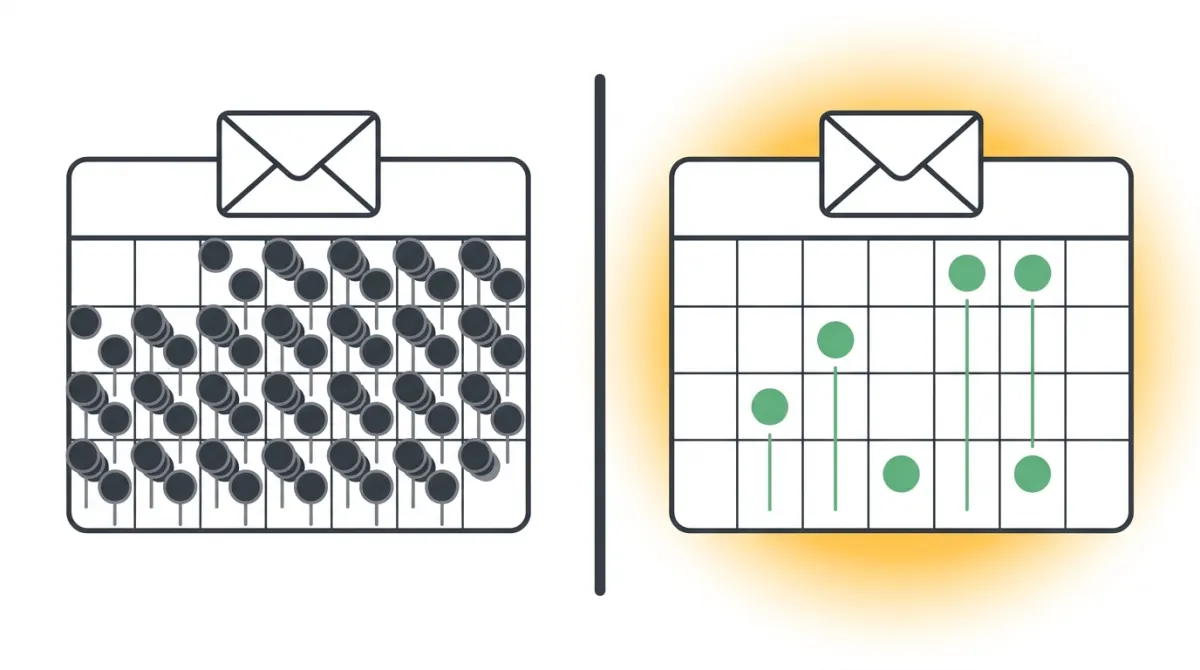
One of the most common causes of perceived over-sending is mixing a scheduled newsletter with triggered or lifecycle emails on the same reputation and the same subscriber view, without any coordination. If a subscriber receives your weekly newsletter and also an unrelated automated email on the same day, it can feel like you are sending too often even though each message individually is reasonable. Keeping your scheduled newsletter and your automated sequences visible side by side, so you can see overlap before it happens, is one of the simplest ways to prevent accidental over-sending. Teams managing both often rely on a dedicated newsletter platform for the scheduled calendar, paired with newsletter automation to handle triggered messages like welcome sequences or re-engagement emails on their own timing, independent of the main newsletter schedule.
Step 5: Re-Test Periodically, Not Just Once
Subscriber expectations and your own content capacity change over time, so a cadence that worked a year ago may no longer be optimal. Revisit frequency roughly every quarter, or whenever you notice a sustained shift in open rates, list growth, or unsubscribe trends, rather than assuming your initial decision is permanent.
Quick Reference Checklist
- Start conservative, especially with a new or recently imported list.
- Segment by engagement before testing a frequency increase.
- Change one variable at a time during a test period.
- Track unsubscribe rate, open rate, and spam complaints as a trio, not in isolation.
- Keep scheduled newsletters and triggered automations clearly separated on the calendar.
- Revisit your cadence every few months rather than treating it as fixed forever.
Ultimately, the answer to how often to send a newsletter is the frequency your specific audience responds to best, confirmed through your own data rather than borrowed from someone else's benchmark. A disciplined, segment-aware testing process will get you there faster and more safely than guessing at a universal number.
Frequently asked questions
Is it better to send a newsletter weekly or monthly?
Neither schedule is automatically better. Weekly newsletters can suit audiences that expect frequent updates and businesses with a steady supply of useful content. Monthly newsletters may work better when each edition requires more preparation or when subscribers prefer fewer messages. Choose the cadence you can maintain consistently, then compare engagement, unsubscribes, spam complaints, and conversions across comparable periods.
How do subscriber expectations shape your sending schedule?
Subscriber expectations should guide your starting cadence. Set expectations when people subscribe by explaining what they will receive and how often. A schedule that matches the signup promise is easier to maintain and less likely to feel intrusive. If your content plan changes, explain the change clearly and provide a preference or unsubscribe option so subscribers can control their inbox experience.
Can I send more emails to my most engaged subscribers?
You can test a higher frequency with engaged subscribers, provided the content remains relevant and the increase is gradual. Segment contacts by recent opens, clicks, purchases, or other meaningful actions, rather than assuming every subscriber wants more email. Monitor complaints, unsubscribes, and deliverability for that segment. Keep less engaged subscribers on a lighter schedule or invite them to update their preferences.
How should I change frequency after a long gap?
After a long gap, resume with a clear reintroduction rather than immediately sending several messages. Remind subscribers why they joined, explain what they can expect, and send content that provides clear value. Review engagement and remove or suppress contacts that no longer want messages. A gradual return can help you identify active subscribers while reducing the risk of sudden disengagement or complaints.
Should automated emails count toward newsletter frequency?
Yes, automated emails should count when assessing the total message load for a subscriber. Welcome messages, abandoned-cart emails, product updates, and other triggered messages compete for the same attention as newsletters. Coordinate these streams with your newsletter calendar, use frequency limits where appropriate, and consider whether a subscriber should receive a newsletter when a time-sensitive automated message has just been sent.
When is declining performance caused by content rather than frequency?
Declining performance may reflect weaker content instead of an unsuitable schedule. Compare subject lines, topics, calls to action, audience segments, and email quality before changing frequency. If opens or clicks fall while subscribers still show interest in related messages, improve relevance and presentation first. A frequency reduction is more appropriate when complaints, unsubscribes, or inactivity rise alongside signs that subscribers feel overmessaged.