Lumail vs beehiiv: Agent Operations or Publication Growth?
Compare Lumail and beehiiv by AI-agent access, automation, pricing model, transactional email, and publishing tools to pick the right newsletter platform.
In this guide
Lumail is a beehiiv alternative with write-access MCP on every plan and send-volume pricing. beehiiv prices by subscriber tier, with unlimited sends, and keeps MCP write access on Scale. beehiiv is a publication-growth product: hosted website, recommendations, ads, paid subscriptions. Lumail is an email operating system: campaigns, graph workflows, and transactional messages that an agent, a script, or a person can drive.
The biggest difference is not a feature checkbox. It is who, or what, does the work each week. This comparison uses public product information available on August 9, 2026. Check both pricing pages before buying, because plans and limits change. If you prefer a condensed version first, the side-by-side comparison table covers the same facts in one screen.
Lumail vs beehiiv at a glance
| Decision | Lumail | beehiiv |
|---|---|---|
| Core focus | Newsletters, workflows, transactional email, and AI-agent operations | Newsletter growth, hosted publishing, and monetization |
| AI-agent access | 89 organization-scoped MCP tools with full write access on every plan | Read-only MCP on Launch; write access starts on Scale |
| Pricing basis | Email volume, with unlimited subscribers on every plan | Plan and subscriber tier, with unlimited sends |
| Free plan | 3,000 emails per month, no credit card | 2,500 subscribers and unlimited sends |
| Automation | Graph-based workflows on every plan | Available on Scale and above |
| Transactional email | API or SMTP in the same organization | Send API reserved for Enterprise |
| Publishing | Capture pages for subscriber acquisition | Hosted newsletter website, podcast, and publication tools |
| Best fit | Teams that want email as a programmable system | Publishers focused on audience growth and monetization |
beehiiv's current plans and limits come from its official pricing page. Lumail's plans are on the Lumail pricing page.
Choose Lumail if agents should operate the whole platform
This is the core difference, so it comes first.
Lumail exposes the entire platform through 89 organization-scoped MCP tools. Subscribers, tags, segments, campaigns, workflows, delivery data, transactional sends: an agent can read them and write them. The same operations run inside ChatGPT, Claude, Claude Code, Cursor, Hermes, and OpenClaw, plus a CLI, a TypeScript SDK, and a REST API. Every interface sees the same organization state, and write access is not gated by plan. The free tier has the same tool surface as Business.
In practice that means an agent can turn a brief into a draft campaign, define the audience, inspect the rendered email, wire a workflow branch, and report the results, while a human keeps the send button. The visual editor is not a fallback; it is the same campaign the agent prepared, open for a final pass. The AI email marketing guide walks through a concrete approval workflow.
beehiiv also ships an MCP integration, and it matters how it is tiered. On the Launch plan the MCP is read-only: an assistant can look at your publication but cannot change it. Write access arrives on the Scale plan. If your process depends on an agent that drafts, edits, and manages, not just summarizes, you either pay for Scale or work around the limitation. With Lumail, the question never comes up.
The distinction sounds subtle until you try to build on it. A read-only integration answers questions. A write-capable one does work. If you are evaluating platforms because your team increasingly runs through an assistant or a terminal, test the write path on both before deciding.
Choose beehiiv if publication growth is the product
beehiiv is built around the publication itself. You get a hosted newsletter website, podcast support, and publication tools without assembling separate software. Its recommendation network and ad network are genuine growth and revenue channels that Lumail does not offer, and paid subscriptions are native to the platform.
If your business is the newsletter, meaning you grow an audience, monetize it through ads, sponsorships, recommendations, and paid tiers, and want the website handled for you, beehiiv's stack is designed for exactly that. Unlimited sends on every plan also removes any hesitation about publishing frequency.
Lumail provides capture pages and web domains for subscriber acquisition, but it is not trying to be a hosted publication. There is no ad network and no recommendation marketplace. Its focus is the email system: audiences, campaigns, workflows, delivery, and the programmable surface around them.
Compare automation and workflows
beehiiv's automations are available on Scale and above. If you are on the free Launch plan and need a welcome sequence or a re-engagement flow, that is a plan upgrade.
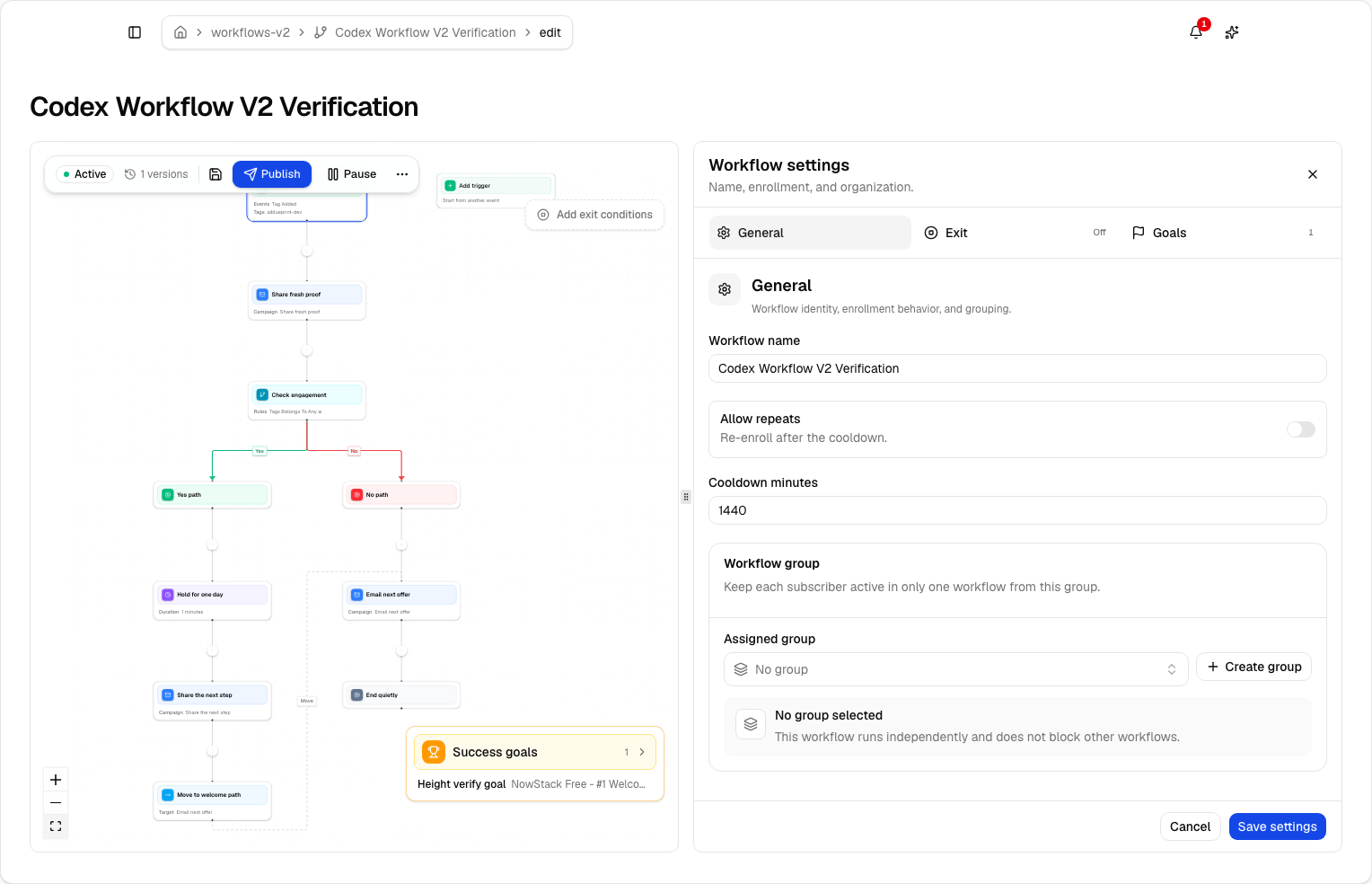
Lumail includes its graph-based workflow engine on every plan, including Free:
- subscriber, tag, event, schedule, and manual triggers;
- email, wait, action, and webhook steps;
- condition, event, and weighted branches;
- goals, exit rules, and A/B paths;
- the same workflows editable from the app, MCP, CLI, SDK, and API.
That last point is the recurring theme: a workflow an agent can inspect and modify is a different asset than a workflow locked behind a visual editor. The workflow documentation covers the model in detail.
Compare the pricing model, not only the starting price
Pricing is the second differentiator, not the first, but the models are genuinely different and worth modeling.
beehiiv prices by plan and subscriber tier, with unlimited sends. The free plan covers up to 2,500 subscribers. The Scale plan starts at $43 per month billed annually, and the tier grows with your list. The generous part is sending: you can publish daily without watching a meter. The constraint is audience size, because growth alone moves you up tiers whether or not you email those subscribers more.
Lumail prices by email volume, with unlimited subscribers on every plan. Free includes 3,000 emails per month with no credit card. Premium is $20 per month with 40,000 emails included, then $0.60 per 1,000. Business is $200 per month with 400,000 included, then $0.40 per 1,000. Storing a subscriber costs nothing; sending is what you pay for.
A worked example
Take a 10,000-subscriber list with a weekly newsletter, roughly 43,000 emails per month.
- On Lumail Premium: $20 base, plus 3,000 emails over the included 40,000, which is about $1.80 in overage. Roughly $22 per month, and the bill does not change if the list grows to 15,000 people you email selectively.
- On beehiiv: 10,000 subscribers is past the free plan's 2,500 limit, so you are on a paid tier priced by that subscriber count, starting from $43 per month billed annually at the bottom of Scale. Sends are unlimited, so a second weekly edition costs nothing extra.
Now invert the usage. A daily newsletter to the same 10,000 subscribers is around 300,000 emails per month, and beehiiv's unlimited sending clearly favors that pattern. A 50,000-subscriber list that receives one targeted campaign per month favors Lumail, because those subscribers cost nothing to store and you only pay for the sends.
The honest summary: beehiiv rewards high frequency to a bounded list; Lumail rewards large or selectively-contacted audiences. Model your own numbers on both pricing pages before deciding. Also note which capabilities are attached to which tier, since on beehiiv, automations and write-capable MCP arrive with Scale, and the transactional Send API is reserved for Enterprise.
Compare transactional email
Lumail supports transactional email in the same organization as campaigns and workflows, on every plan. You can send through the REST API, the SDK, agent tools, or the SMTP relay at smtp.lumail.io on port 587 with STARTTLS. One domain, one suppression state, one operating surface for the newsletter and the password-reset email.
beehiiv reserves its Send API for Enterprise. For most beehiiv customers, product and account email means running a second provider alongside the newsletter platform, with a second domain setup and a second place to check deliverability. That is a reasonable trade for a pure publication, and a real cost for anything with an application attached.
See transactional email vs marketing email for why keeping the two streams coherent matters for deliverability.
Which platform should you choose?
Choose Lumail when your priority is:
- AI agents with full write access to campaigns, subscribers, and workflows on every plan;
- one system for newsletters, lifecycle workflows, and transactional email;
- MCP, CLI, SDK, and REST API beside a visual and AI-assisted editor;
- pricing based on emails sent rather than audience size;
- graph-based workflows without a plan gate.
Choose beehiiv when your priority is:
- a hosted publication with website, podcast, and publishing tools;
- the ad network and recommendation network as growth channels;
- native paid subscriptions;
- unlimited sends to a list you email frequently;
- newsletter-specific analytics and monetization in one place.
Neither list makes one product wrong. beehiiv is a media business in a box. Lumail is an email system your team, and your agents, can program.
A low-risk migration plan
If you decide to move from beehiiv, prove the operating loop before moving the audience.
1. Export complete subscriber state
Export active subscribers, unsubscribes, and any segmentation you rely on. Import suppressions, not just the active list; historical exclusions protect compliance and sender reputation.
2. Authenticate the sending domain
Configure SPF and DKIM, verify the domain, and decide whether the From address changes. Keep beehiiv live while DNS propagates and tests run.
3. Rebuild one automation as a graph workflow
Take your welcome sequence and recreate it with a trigger, waits, branches, a goal, and an exit condition. Run a test subscriber through the success path and the early-exit path.
4. Give an agent one real task
This is the step unique to this migration. Connect Lumail's MCP to the assistant you already use and have it draft next week's edition, define the audience, and report the recipient estimate. If the agent-native surface is why you are moving, verify it does your actual work before the full list arrives.
5. Send one representative campaign
Use a consented segment with normal engagement. Verify personalization, rendering, links, unsubscribe behavior, and delivery events before scheduling anything bigger.
Frequently asked questions
Is Lumail a beehiiv alternative with write-access MCP?
Yes. Lumail exposes write MCP on every plan, including Free. beehiiv MCP is read-only on Launch; write access starts on Scale.
Is Lumail cheaper than beehiiv?
It depends on list size and send frequency. beehiiv prices by subscriber tier with unlimited sends, which favors high-frequency publishing to a bounded list. Lumail prices by volume with unlimited subscribers, which favors large or selectively contacted audiences.
What is the main difference between Lumail and beehiiv?
beehiiv is a publication-growth product: hosted website, recommendations, ads, paid subscriptions. Lumail is an email operating system: campaigns, graph workflows, transactional email, and agents with write access on every plan.
Can I migrate from beehiiv to Lumail?
Yes. Export subscribers and suppressions, authenticate the domain, rebuild one automation as a Lumail workflow, connect MCP, and send one campaign before moving the full list. Plan separately for ads, recommendations, and paid subscriptions—Lumail does not replace those.
Try the operating model before you commit
The decisive test is not a feature tour. Reproduce one week of your real process on each platform and count the manual steps, including the ones an agent could have done for you.
You can start Lumail free with 3,000 emails per month and no credit card, or read the documentation first. Still mapping the market? The email platform comparison hub covers Mailchimp, MailerLite, Kit, Substack, Brevo, ActiveCampaign, Loops, Buttondown, and Resend as well.