Lumail vs Omnisend: Which Email Platform Fits How You Work?
Omnisend bills by billable contacts for ecommerce email, SMS, and push. Lumail bills by emails sent, stores unlimited subscribers, and lets agents run it.
In this guide
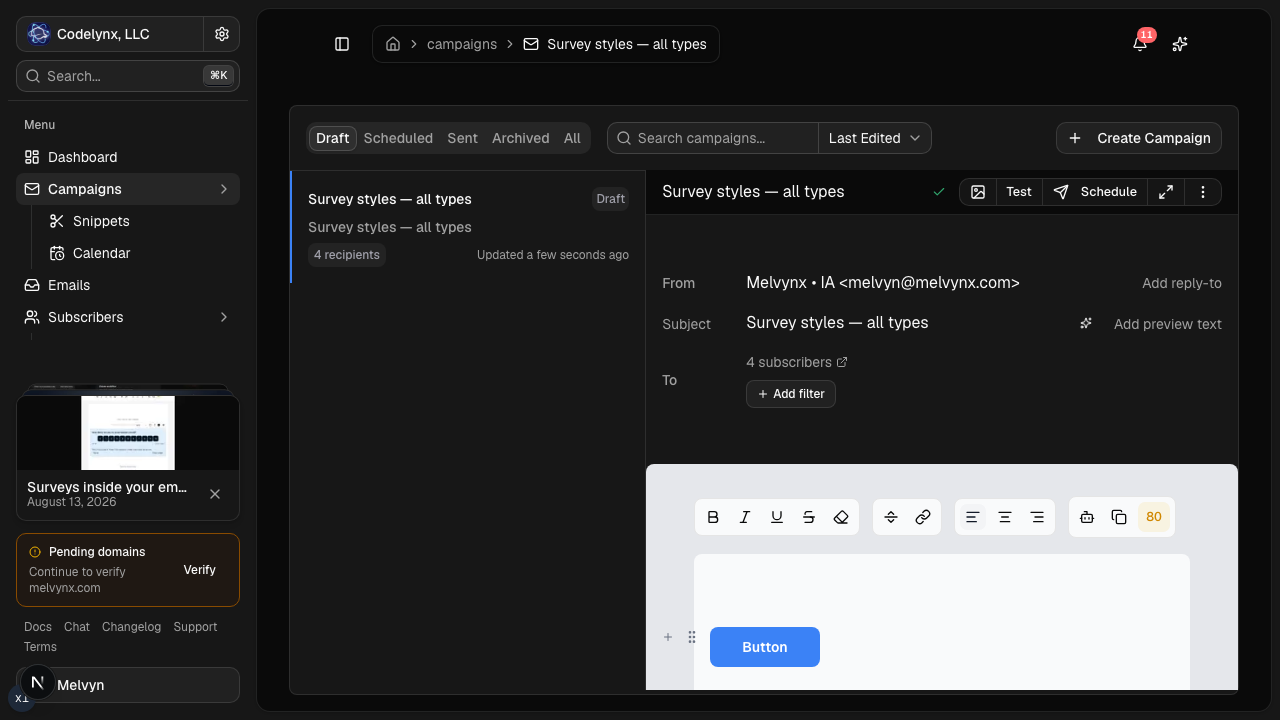
Omnisend is an ecommerce marketing platform that prices by billable contacts and pairs email with SMS and web push for online stores; Lumail is an email platform that prices by emails sent and is built so AI agents and developers can operate it. Both send campaigns and run automations. Omnisend's edge is store-native flows. Lumail's is a programmable email system with transactional sending built in.
Omnisend sells itself on being a simpler, cheaper option for stores on Shopify, WooCommerce, and BigCommerce, and it will migrate your lists, flows, and templates for free. Lumail is not a store tool; it is the email layer, reachable from the app, agents, and code. Omnisend facts here come from its official pricing page as of August 2026; plans change, so check before you buy. For the compact version, see the side-by-side comparison table.
Lumail vs Omnisend at a glance
| Decision | Lumail | Omnisend |
|---|---|---|
| Core focus | Campaigns, workflows, transactional email, and AI agents | Ecommerce email, SMS, and web push for online stores |
| Pricing basis | Emails sent; unlimited subscribers on every plan | Billable contacts, including non-subscribed store customers |
| Free plan | 3,000 emails per month, no credit card | 250 contacts and 500 emails per month, Omnisend branding |
| Paid entry | Premium at $20/month with 40,000 emails | Standard at $16/month for 500 contacts and 6,000 emails |
| AI and developer access | 89 MCP tools, CLI, TypeScript SDK, REST API | In-app AI, compact MCP server, REST API; no CLI or SDK |
| Automation | Graph workflows on every plan | Visual workflows with 15+ ecommerce presets |
| Transactional email | Built in through the API or SMTP | Order and shipping emails triggered by store events only |
| Best fit | Teams running email through agents, code, and a visual app | Shopify, WooCommerce, and BigCommerce stores wanting SMS too |
Lumail's current plans are on the Lumail pricing page.
Choose Lumail if AI agents should operate your email
Omnisend offers a remote MCP server that works with ChatGPT, Claude, Cursor, and Claude Code on every plan, plus a REST API and in-app AI for copy, subject lines, and segments. The MCP server is compact: four to seven generic tools that search and call its REST API. There is no official CLI or TypeScript SDK.
Lumail exposes 89 organization-scoped MCP tools, each named for a real operation across campaigns, subscribers, tags, segments, workflows, templates, analytics, and transactional sending. The same operations run in ChatGPT, Claude, Claude Code, and Cursor, and through a CLI, a TypeScript SDK, and a REST API. An agent works on your real audience and real workflow state.
In practice you can ask an assistant to:
- build or edit a workflow graph, not only a campaign;
- tag and segment subscribers before a targeted send;
- trace why a subscriber took a specific branch;
- send a receipt or password reset from the same account;
- summarize last month's results without exporting a CSV.
You keep consequential actions behind human approval and finish drafts in the visual editor.
Choose Lumail if you store a large list and do not want checkout customers you never emailed to raise your bill, or if your product needs transactional email next to its newsletter.
Choose Omnisend if you run an online store and want SMS in the same flows
Omnisend is built for stores, and it is priced to win them from bigger suites. Its integrations sync orders and browsing, and its presets cover the flows that make money for a shop.
Choose Omnisend if:
- you sell on Shopify, WooCommerce, or BigCommerce and want cart, browse, and order flows ready to go;
- you need SMS and web push in the same workflows as email;
- you want Omnisend's team to migrate your lists, flows, segments, and templates for you.
Lumail does not try to be a store marketing suite. It has no SMS, web push, or product sync. Its focus is the email system: audiences, campaigns, graph workflows, transactional delivery, and the programmable surface around them.
Compare the pricing models, not the starting prices
Omnisend prices by billable contacts. That includes subscribers and also people who can receive automations without subscribing, such as checkout customers and abandoned-cart contacts. Unsubscribed contacts are not billed. Standard gives you 12 emails per contact per month, so 3,000 contacts get 36,000 emails, and campaigns stop when you run out. Pro starts at $59/month for 2,500 contacts with unlimited email. For paid plans started after May 4, 2026, SMS is a Pro-only add-on.
Lumail prices by emails sent, with unlimited subscriber storage on every plan:
- Free: 3,000 emails per month, no credit card;
- Premium: $20/month with 40,000 emails included, then $0.60 per 1,000;
- Business: $200/month with 400,000 emails included, then $0.40 per 1,000.
A worked example
Say your store has 2,500 billable contacts and you email everyone twice a week. That is about 20,000 emails a month.
On Lumail, that is Premium: $20 for the first 40,000 emails, so $20 for the month. Adding checkout customers who never subscribed would not change it.
On Omnisend, 2,500 contacts is the entry point for Pro at $59/month with unlimited email. Standard at that size would include 30,000 emails, and its price for 2,500 contacts is on Omnisend's calculator rather than the page. Either way, every checkout customer who lands in your account counts toward the tier.
The comparison flips for very small stores. At 500 contacts and 6,000 emails, Omnisend Standard at $16 is cheaper than Lumail Premium at $20. Model your real contact count, including non-subscribers, before deciding.
Compare automation and transactional email
Omnisend's automation editor is visual and ecommerce-first. More than 15 presets cover welcome, abandoned cart and checkout, browse abandonment, order follow-up, reviews, cross-sell, and birthdays. Workflows can mix email, SMS, and web push, with splits, A/B tests, and custom-event triggers.
Lumail's workflow engine is graph-based and included on every plan, including Free. It supports subscriber, tag, event, schedule, and manual triggers; email, wait, action, and webhook steps; condition and weighted branches; and goals and exit rules. The same graph is readable and editable from the app, MCP, CLI, SDK, and API.
Transactional email is the sharper split. Omnisend's order, shipping, and cancellation confirmations are automation presets that fire on store events. It has no SMTP relay and no API for a one-off password reset. Lumail sends transactional messages from the same organization through the API or SMTP relay at smtp.lumail.io:587 with STARTTLS.
Migrating from Omnisend to Lumail
Move the email program first and leave store-tied channels until last.
- Export contacts and suppressions. Export subscribers, unsubscribes, and the consent data you rely on. Leave non-subscribed store customers out of marketing lists.
- Authenticate your sending domain. Configure SPF and DKIM in Lumail and verify the domain. Keep Omnisend live while DNS propagates.
- Rebuild one workflow. Recreate your welcome series as a graph workflow, then test success, unsubscribe, and early-exit paths with test subscribers.
- Send one representative campaign. Use a consented segment and check rendering, links, and unsubscribe behavior before scheduling to everyone.
- Decide what stays. SMS, web push, and store-event order confirmations have no Lumail equivalent. Keep them on your store platform or another tool.
Frequently asked questions
Is Lumail an Omnisend alternative?
Yes, for email campaigns, automations, transactional email, and agent access. If you need SMS, web push, or store-native cart and order flows, Omnisend remains the better fit.
Is Lumail cheaper than Omnisend?
It depends on billable contacts versus sends. Stores with many non-subscribed customers or large lists usually pay less on Lumail; a tiny list can be cheaper on Omnisend Standard at $16/month.
What is the main difference between Lumail and Omnisend?
Omnisend is an ecommerce suite for email, SMS, and push, billed by contacts. Lumail is an email platform billed by volume, with graph workflows, built-in transactional email, and 89 named MCP tools.
Can I migrate from Omnisend to Lumail?
Yes. Export contacts and suppressions, authenticate your domain, rebuild workflows as graphs, and send a test campaign. SMS, push, and store-triggered confirmations do not carry over.
Which one should you choose?
Choose Omnisend if you run an online store and want email, SMS, and web push tied to orders and carts in one dashboard, with the migration done for you.
Choose Lumail if email is a system you operate: agents working through 89 MCP tools, graph workflows on every plan, transactional email in the same account, and a bill that follows what you send rather than who is in your store database.
You can start Lumail free with 3,000 emails per month and no credit card, review the pricing plans, or browse the full comparison hub. Comparing more than two tools? See the best Omnisend alternatives.