Lumail vs Substack: Which Email Platform Fits You?
Compare Lumail and Substack by AI-agent access, automation depth, transactional email, and pricing model to decide between owned email infrastructure and a hosted paid publication.
In this guide
Lumail is a Substack alternative for teams that need owned email infrastructure: unlimited subscribers, graph workflows, transactional email, and 89 MCP tools. Substack is a hosted publication with a reader network and a 10% revenue share once paid subscriptions are on.
That difference matters more than any single feature. Substack is a hosted publication with a reader network and built-in paid subscriptions. Lumail is an email platform where every operation available in the app is also available to agents and code: campaigns, subscribers, workflows, and transactional email in one organization.
This comparison uses public product information available on August 9, 2026. Check each pricing page before deciding because fees and features can change. For a condensed version, see the side-by-side comparison table.
Lumail vs Substack at a glance
| Decision | Lumail | Substack |
|---|---|---|
| Core focus | Newsletters, workflows, transactional email, and AI-agent operations | Hosted publication, app, community, and paid subscriptions |
| Pricing basis | Flat SaaS plans based on email volume; unlimited subscribers on every plan | Revenue share when paid subscriptions are enabled |
| Free plan | 3,000 emails per month, no credit card | Free publishing for any subscriber count |
| Paid cost | Premium $20/month; Business $200/month | 10% of paid-subscription revenue, plus Stripe fees |
| AI and developer access | 89 organization-scoped MCP tools, CLI, TypeScript SDK, REST API | No equivalent organization-wide MCP, CLI, SDK, and REST surface |
| Automation | Graph-based workflows with triggers, branches, goals, and exits | Publication and subscriber features rather than graph workflows |
| Transactional email | API or SMTP in the same organization | Not a transactional email API |
| Best fit | Teams that operate email through agents, code, and a visual app | Writers who want the shortest path to a hosted paid publication |
Substack's current model comes from its official fees page. Lumail's current plans are listed on the Lumail pricing page.
Choose Lumail if AI agents operate your email
The clearest difference between the two products is not price. It is who, and what, can run the platform.
On Substack, you write in the editor and the platform handles the rest. That simplicity is the product. There is no equivalent organization-wide MCP, CLI, SDK, and REST surface, so your assistant can help you draft a post, but it cannot manage your audience, inspect a rendered email, or reason about your delivery data.
Lumail exposes the entire platform through 89 organization-scoped MCP tools. The same operations available in the dashboard work inside ChatGPT, Claude, Claude Code, Cursor, Hermes, and OpenClaw, and through the CLI, TypeScript SDK, and REST API. In practice that means an agent can:
- draft a campaign from a brief and leave it for your review;
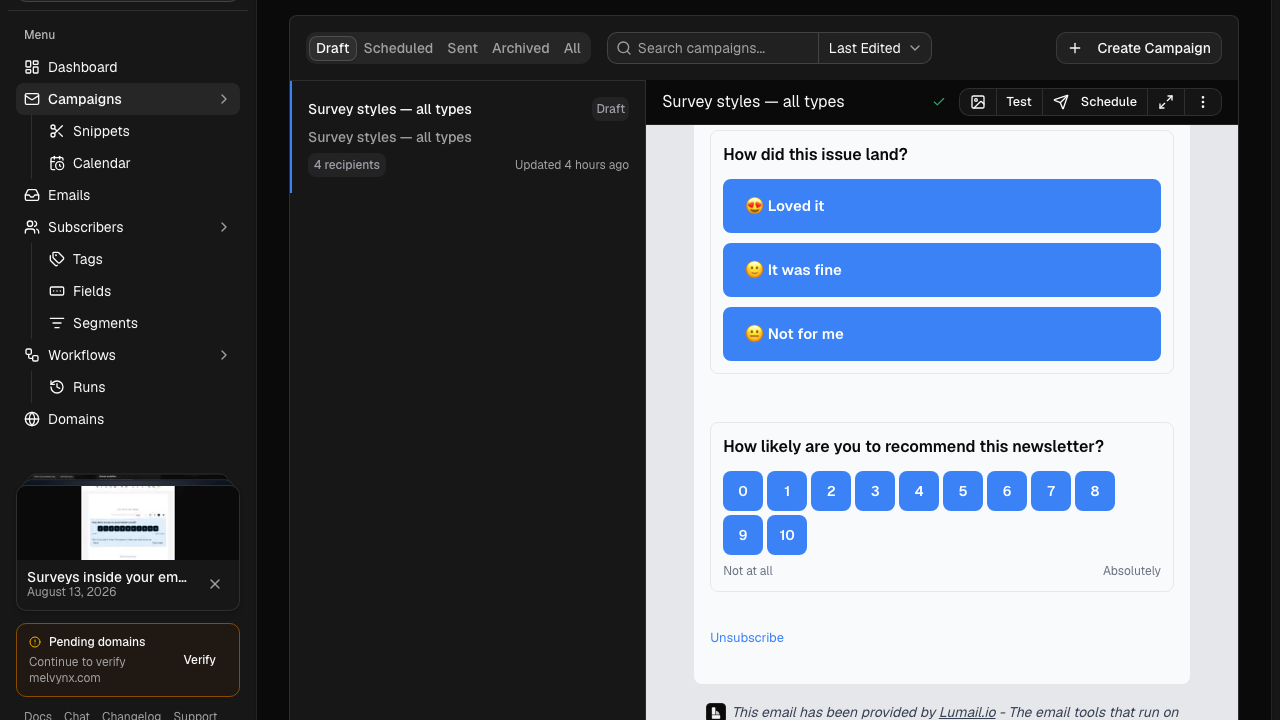
- segment subscribers by tags, events, or engagement and report the recipient count;
- inspect the final rendered email before anything is scheduled;
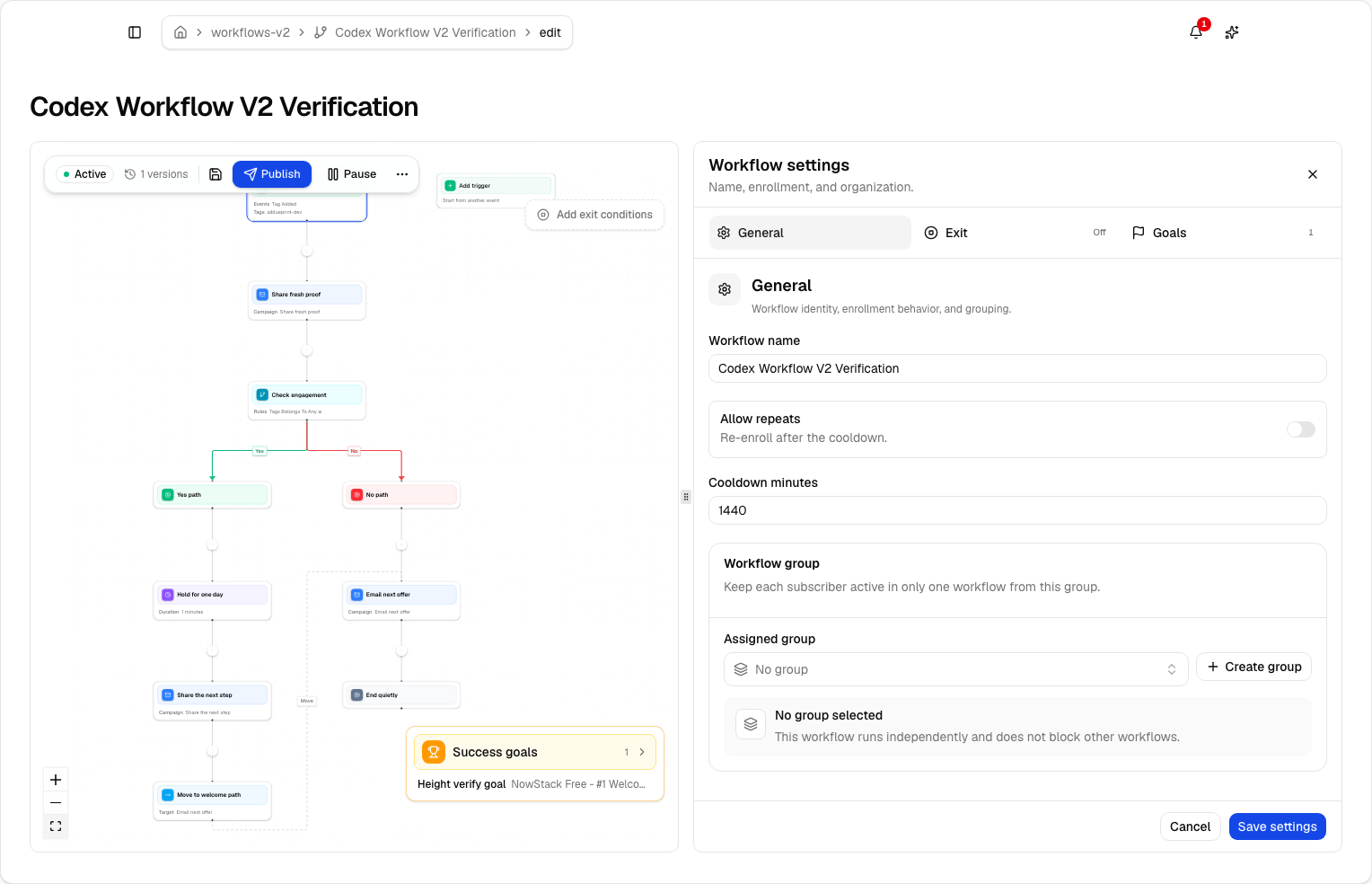
- build or modify a graph-based workflow;
- summarize campaign results and answer why a specific subscriber did or did not receive a message.
You keep consequential actions behind human approval and finish drafts in the visual editor with AI assistance. The agent surface is not a chat widget bolted onto a publishing tool; it is the same organization-aware operation set the app uses.
If your writing and operations already live in a terminal, an assistant, or a product backend, this is the deciding factor. Substack cannot participate in that loop.
Choose Substack if you want a hosted publication with minimal setup
Substack's strengths are real and worth stating plainly. There is no monthly platform fee for free publications. Paid subscriptions are built in, with billing handled for you. Setup and publishing friction is about as low as it gets: pick a name, write, publish, and your publication exists with a website, an app presence, and community features.
The reader network is the other genuine differentiator. Substack recommendations and discovery can send you subscribers you did nothing to acquire. If that network is part of your growth strategy, no self-owned email platform replicates it.
Choose Substack when:
- you want a hosted publication with minimal setup;
- Substack's reader network is part of your growth strategy;
- you prefer revenue share over a recurring software subscription.
Lumail does not host a publication for you. It provides capture pages for subscriber acquisition, but the product is the email system itself: audiences, campaigns, workflows, delivery, and programmable access. If you want a place where readers browse and discover your writing, Substack does that and Lumail does not.
Compare the pricing models with a worked example
Substack charges nothing until you enable paid subscriptions. From that point it takes 10% of paid-subscription revenue, plus Stripe fees, as of August 9, 2026 per its fees page. Lumail charges a flat SaaS price based on email volume: Free includes 3,000 emails per month with no credit card, Premium is $20/month with 40,000 emails included then $0.60 per 1,000, and Business is $200/month with 400,000 included then $0.40 per 1,000. Subscribers are unlimited on every plan.
The models diverge sharply as paid revenue grows. Take a publication with 500 paid subscribers at $8/month:
- Monthly paid revenue: $4,000.
- Substack's share at 10%: $400/month, or $4,800/year, before Stripe fees.
- The same publication sending 8 emails per month to a total list of 10,000 sends 80,000 emails. On Lumail Premium that is $20 plus 40,000 overage emails at $0.60 per 1,000, or $24 in overage: $44/month, about $528/year.
The revenue share scales with your success; the flat plan scales with your sending. At $40,000/month in paid revenue, Substack's share is $4,000/month while the email bill on Lumail depends only on volume. In the other direction, a free publication with no paid subscribers costs nothing on Substack forever, while on Lumail it costs nothing only up to 3,000 emails per month.
Run your own numbers with three inputs: current paid revenue, expected revenue in twelve months, and total emails sent per month. The Lumail pricing page has the full plan details. The honest summary: Substack is cheaper before you monetize, and Lumail is usually much cheaper after.
There is a second, quieter cost dimension: ownership. On Lumail you send from your own authenticated domain with your own SPF and DKIM, and your subscriber data, suppressions, and delivery events are exportable, queryable state that your tools can read. That matters if you ever want to change platforms, or if your business depends on infrastructure you control.
Compare automation and transactional email
Substack offers publication and subscriber features rather than graph workflows. That fits its model: you publish, readers subscribe, some pay.
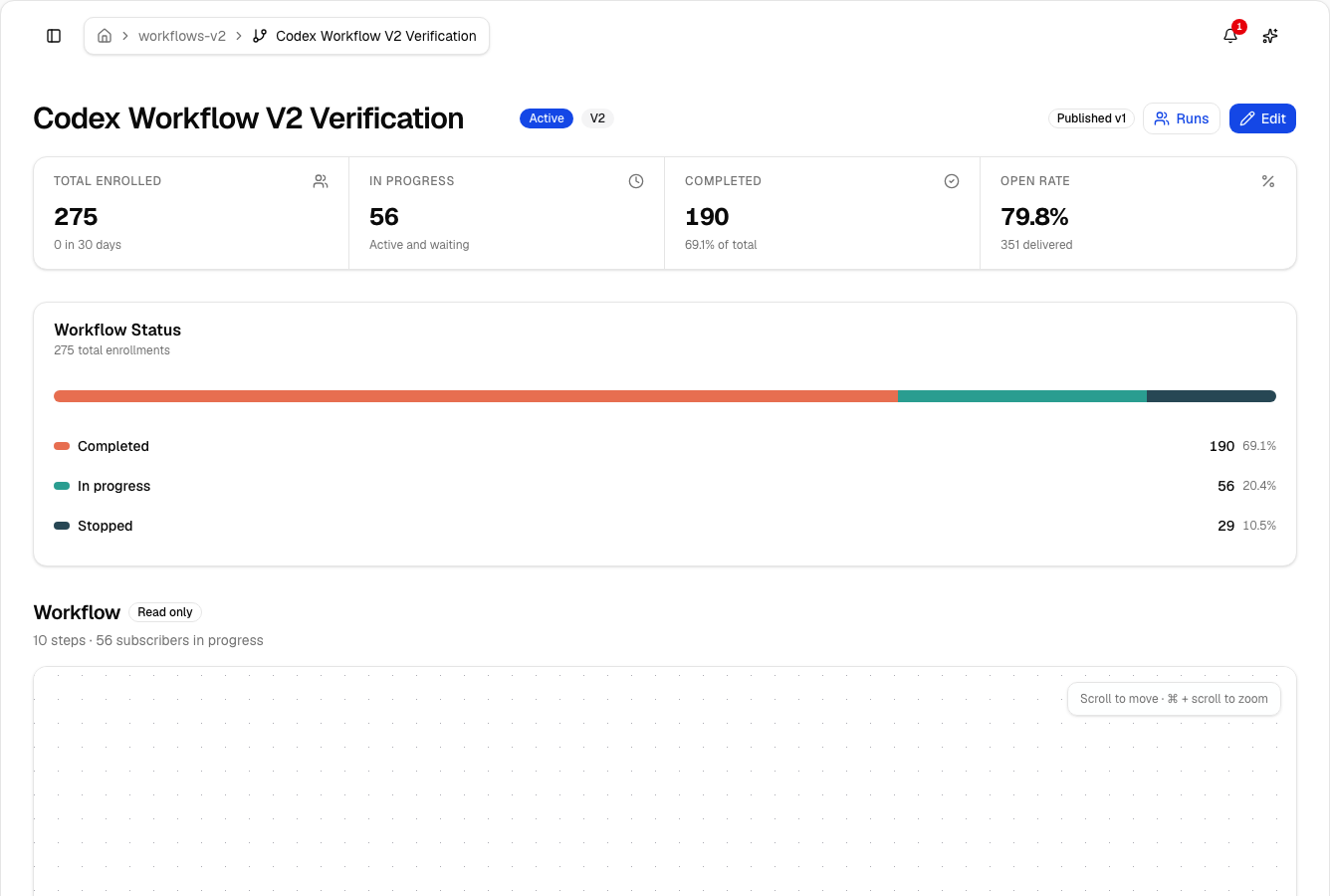
Lumail uses a graph-based workflow engine with subscriber, tag, event, schedule, and manual triggers; email, wait, action, and webhook steps; condition and weighted branches; goals and exit rules. Workflows are editable in the app and through the same MCP, CLI, SDK, and API surface, so an agent can build a welcome sequence or diagnose why a subscriber took a particular path.
Transactional email is a similar story. Substack is not a transactional email API. Lumail sends transactional messages through the REST API or through the SMTP relay at smtp.lumail.io on port 587 with STARTTLS, inside the same organization as your campaigns and workflows. If your newsletter sits next to a product that sends receipts, magic links, or notifications, one platform covers both streams.
Which platform should you choose?
Choose Lumail when your priority is:
- AI agents and developer tools operating campaigns, workflows, and subscribers directly;
- advanced segmentation and graph-based automations;
- transactional email, APIs, or agent operations beside your newsletter;
- avoiding a 10% platform share on paid revenue as your publication grows;
- owned sending infrastructure and portable subscriber data.
Choose Substack when your priority is:
- a hosted publication with minimal setup;
- built-in paid subscriptions with billing handled for you;
- Substack's reader network and discovery as a growth channel;
- paying nothing until, and unless, you monetize.
Neither list makes one product universally better. Substack optimizes for the writer who wants to publish and be discovered. Lumail optimizes for the team that treats email as an operated system.
A low-risk migration plan
If you are moving from Substack, prove the system before moving the audience.
1. Export clean subscriber state
Export your full subscriber list, including unsubscribes and any suppression state you rely on. Importing only active readers and losing historical exclusions risks both compliance and sender reputation.
2. Authenticate your own sending domain
Configure SPF and DKIM and verify the domain. This is the step Substack handled invisibly, and it is also the step that makes the audience yours: mail now comes from a domain you control, not a platform you rent.
3. Rebuild one sequence and one campaign
Recreate a welcome sequence as a graph workflow, run a test subscriber through it, and verify the path. Then send one representative campaign to a consented segment and check rendering, links, unsubscribe behavior, and the recipient count.
4. Wire in your agent workflow
This is the part with no Substack equivalent, so test it deliberately. Connect Lumail to the assistant you already use, have it draft a campaign from a brief, inspect the rendered result, and report on the send. Decide which actions stay behind human approval.
5. Solve monetization separately
Substack bundles paid subscriptions; Lumail does not run your billing. If paid content is part of your model, plan how payments and gated delivery work before migrating, and weigh that setup cost against the ongoing 10% share.
Frequently asked questions
Is Lumail a Substack alternative?
Yes, if you want owned email infrastructure rather than a hosted publication. Lumail does not replace Substack's reader network, app, or built-in paid billing.
Is Lumail cheaper than Substack?
Substack is free until paid subscriptions are on, then it takes 10% of paid revenue plus Stripe fees. Lumail is a flat SaaS bill based on email volume. A growing paid list usually costs less on Lumail; a free publication with no paid revenue costs less on Substack.
What is the main difference between Lumail and Substack?
Substack is a hosted publication. Lumail is an email operating system: campaigns, graph workflows, transactional email, and 89 MCP tools.
Can I migrate from Substack to Lumail?
Yes. Export subscribers, authenticate the domain, rebuild one sequence as a workflow, and send one campaign. Solve paid billing separately—Lumail does not run subscriptions.
Try the workflow that matters most
Before moving a full list, reproduce one real loop: import a controlled subscriber set, build one workflow, send one campaign, and operate all of it once through an agent or the CLI. Measure what your weekly process actually looks like on each platform.
You can start Lumail free with 3,000 emails per month and no credit card, or review the documentation first. Still evaluating? Browse the side-by-side comparison table or the complete email platform comparison hub for Mailchimp, Kit, beehiiv, MailerLite, Brevo, ActiveCampaign, Loops, Buttondown, and Resend.