Lumail vs Systeme.io: Which Email Platform Fits How You Work?
Systeme.io bundles funnels, courses, and unlimited sends priced by contacts. Lumail is email only: billed by emails sent, with transactional email and MCP.
In this guide
Lumail is an email platform that bills by emails sent, with unlimited subscribers on every plan. Systeme.io is an all-in-one platform for online businesses, with funnels, courses, websites, affiliates, and unlimited marketing emails, priced by contact count from a free plan to $97/month.
Systeme.io is one of the cheapest ways to run a whole offer stack, and for many solo sellers it is the right call. Lumail is narrower: it is the email system, built so AI agents can operate it. Systeme.io facts in this comparison come from its official pricing page as of August 2026. Verify current limits before purchasing, and see the side-by-side comparison table for the compact version.
Lumail vs Systeme.io at a glance
| Decision | Lumail | Systeme.io |
|---|---|---|
| Core focus | Campaigns, workflows, transactional email, and AI-agent operations | Funnels, courses, websites, affiliates, and email in one account |
| Pricing basis | Email volume; unlimited subscribers on every plan | Contact-count tiers; unlimited marketing sends on every plan |
| Free plan | 3,000 emails per month, no credit card | 2,000 contacts with unlimited sends, no credit card |
| Paid entry | Premium at $20/month with 40,000 emails | Startup at $17/month for 5,000 contacts |
| AI and developer access | 89 MCP tools, CLI, TypeScript SDK, REST API | Early-stage MCP server, REST API, and webhooks |
| Automation | Graph workflows included on every plan | Rules plus a visual workflow builder; caps vary by plan |
| Transactional email | Built in through the API or SMTP | Platform notices only; no transactional API or SMTP relay |
| Best fit | Teams operating email through agents, code, and a visual app | Solo sellers running funnels and courses on a tight budget |
Lumail's current plans are on the Lumail pricing page.
Choose Lumail if AI agents should operate your email
This is the structural difference, and it matters more than any single feature row.
Systeme.io has an official MCP server in its initial release, with guides for ChatGPT and Claude. It covers contacts, tags, newsletter drafts, some funnel steps, and simple automation rules, and uses expiring keys rather than OAuth. There is also a REST API and webhooks, but no CLI or TypeScript SDK.
Lumail exposes 89 organization-scoped MCP tools covering subscribers, tags, segments, campaigns, workflows, templates, analytics, and transactional sending. The same operations run inside ChatGPT, Claude, Claude Code, and Cursor, plus a CLI, a TypeScript SDK, and a REST API.
In practice, you can ask an assistant to:
- draft next week's campaign from a brief and your existing template;
- build a segment from tags and engagement before a targeted send;
- read a workflow and explain why a subscriber took a specific branch;
- summarize last month's results without exporting a spreadsheet.
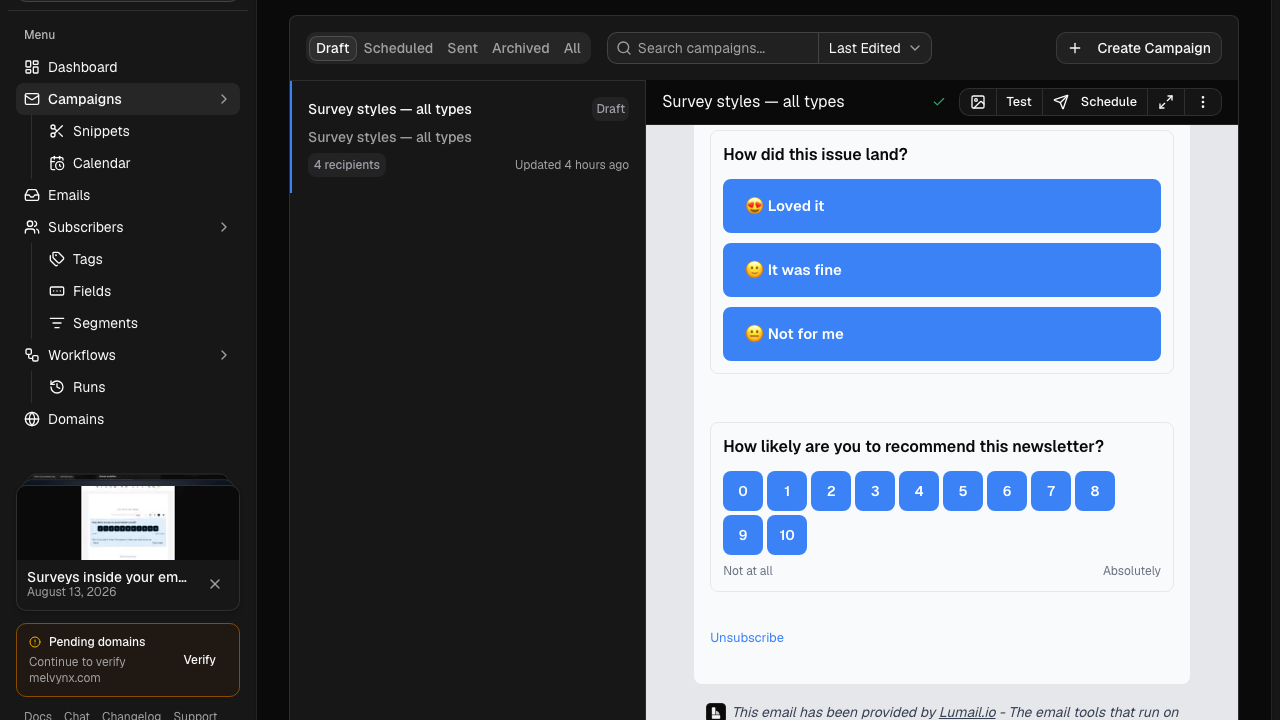
Humans still review and schedule in the visual editor. The point is removing the operational clicking, not the judgment.
Choose Systeme.io if you sell through funnels and courses
Systeme.io's strength is how much it bundles for the price. One account covers sales funnels, a website and blog, courses, communities, a creator store, checkout with no platform transaction fees, affiliate programs, a booking calendar, and evergreen webinars on the Webinar plan. The free plan alone gives you 2,000 contacts and unlimited email sends.
For a solo seller who would otherwise pay for a funnel builder, a course host, and an email tool separately, that is hard to beat.
Choose Systeme.io if:
- you sell digital products through funnels, courses, or webinars;
- you want checkout, affiliates, and a website in the same account;
- your list is small and you email it often, so unlimited sends matter.
Lumail does not host courses, run checkout, or build websites. It offers capture pages for subscriber acquisition, and its scope is the email system itself.
Compare the pricing models, not the starting prices
Systeme.io prices by contacts, with unlimited marketing sends on every plan. Free covers 2,000 contacts. Startup is $17/month for 5,000 contacts, Webinar is $47/month for 10,000, and Unlimited is $97/month with no contact cap. Annual billing gives two months free.
Lumail prices by emails sent, with unlimited subscriber storage on every plan:
- Free: 3,000 emails per month, no credit card;
- Premium: $20/month with 40,000 emails included, then $0.60 per 1,000;
- Business: $200/month with 400,000 emails included, then $0.40 per 1,000.
A worked example
Take three list shapes, each sending a weekly newsletter.
With 2,000 subscribers, you send about 8,000 emails a month. Systeme.io's free plan covers it for $0. Lumail is past its 3,000-email free tier, so Premium at $20.
With 5,000 subscribers, you send about 20,000 emails. Systeme.io Startup is $17. Lumail Premium is $20.
With 20,000 subscribers you email twice a month, about 40,000 emails. Systeme.io needs Unlimited at $97. Lumail Premium is still $20.
For a small list emailed often, Systeme.io is cheaper, and it includes funnels and courses. Lumail wins when the list is large relative to how often you email it, or when you need what Systeme.io does not offer: transactional email and a full agent surface.
Compare automation and transactional email
Systeme.io has two automation layers. Rules are simple "when this happens, do that" steps. Workflows add a visual builder with delays, decisions, and actions such as sending email or SMS, tagging, enrolling in a course, or calling a webhook. Plans cap the number of rules, from one on Free to unlimited on the top plan.
Lumail includes graph workflows on every plan: subscriber, tag, event, schedule, and manual triggers; email, wait, and webhook steps; condition branches; and goals and exit rules. Agents can read and edit the same workflows through MCP.
Systeme.io does not sell a transactional email service. Its own system messages go out from the platform, and you can connect your own SendGrid account for delivery, but there is no transactional API or SMTP relay for your product. Lumail sends receipts, password resets, and other product email through the REST API or smtp.lumail.io:587 with STARTTLS, in the same organization as your campaigns.
Migrating from Systeme.io to Lumail
- Decide what stays. Funnels, courses, checkout, communities, and affiliates do not move. You can keep Systeme.io for sales and use Lumail for email.
- Export contacts and tags. Bring unsubscribes along with active contacts, then import them into Lumail.
- Authenticate your sending domain. Set up SPF and DKIM in Lumail and keep Systeme.io sending while DNS propagates.
- Rebuild rules and workflows. Recreate your welcome and sales sequences as graph workflows. If purchases trigger emails, send those events to Lumail from your checkout.
- Send one campaign and connect agents. Send to a small segment first, then connect MCP to your assistant and run one real task.
Frequently asked questions
Is Lumail a Systeme.io alternative?
Yes for newsletters, automations, and agent access. It is not a replacement for Systeme.io's funnels, courses, checkout, or affiliates.
Is Lumail cheaper than Systeme.io?
It depends on the shape of your list. A small list emailed often is cheaper on Systeme.io, while a large list emailed selectively is often cheaper on Lumail: 40,000 emails is $20 on Lumail versus $97 on Systeme.io Unlimited for 20,000 contacts.
What is the main difference between Lumail and Systeme.io?
Systeme.io is an all-in-one business platform priced by contacts. Lumail is an email platform priced by volume, with transactional email and 89 MCP tools, and no course or funnel builder.
Can I migrate from Systeme.io to Lumail?
You can move the audience, not the Systeme.io business. Export contacts and tags, import them into Lumail, and rebuild your rules as graph workflows.
Which one should you choose?
Choose Systeme.io if you sell digital products through funnels, courses, or webinars and want the whole stack in one low-cost account.
Choose Lumail if email is a system you operate: agents working through 89 MCP tools, transactional email on the same domain, and a bill that follows what you send rather than how many contacts you store.
You can start Lumail free with 3,000 emails per month and no credit card, review the pricing plans, or browse the full comparison hub.