Best Mailgun Alternatives in 2026: 7 Tools Compared
Mailgun alternatives compared on free tiers, per-1,000 overages, inbound routing, and API depth, from Amazon SES and Postmark to an all-in-one platform.
In this guide
The best Mailgun alternatives are Lumail, Amazon SES, Postmark, SendGrid, Resend, SparkPost, and MailerSend, depending on whether you need the lowest cost per email, stronger inbound handling, a cleaner developer experience, or newsletters and workflows next to your app email. Mailgun is a capable email API; teams usually leave over the bill at their volume, add-ons billed separately, or marketing logic they still maintain in code.
We make Lumail, so it is listed first; every other entry is judged on the same criteria with facts from each vendor's pricing page as of August 2026.
Why people look for a Mailgun alternative
- The free tier is small. Free Send is 100 emails a day with one custom sending domain, one inbound route, and one day of logs. That is enough to test an integration, not to run a product.
- Overage adds up fast at low volume. Basic is $15 a month for 10,000 emails, then from $1.80 per 1,000. Mailgun bills extra usage in arrears, and you cannot switch it off.
- Deliverability tools are separate bills. Inbox-placement testing and validation packs live in Optimize (from $49 a month), previews live in Inspect (from $99 a month), and dedicated IPs are $59 per IP per month outside the plans that include one.
- There is no journey builder. Mailgun's own pricing FAQ says there is no send button. Welcome sequences, onboarding drips, and newsletters are code you write and maintain against the Messages API.
Mailgun alternatives at a glance
| Tool | Best for | Free plan | Paid from | Pricing basis |
|---|---|---|---|---|
| Lumail | App email plus newsletters and workflows | 3,000 emails/month, no card | $20/month (40,000 emails) | Email volume, unlimited subscribers |
| Amazon SES | Lowest cost per email on AWS | No standing SES-only allotment | $0.10 per 1,000 emails | Per email sent, no monthly minimum |
| Postmark | Transactional deliverability | 100 emails/month | $15/month (10,000 emails) | Monthly email volume |
| SendGrid | High volume plus an optional marketing product | 60-day trial, 100 emails/day | $19.95/month (Email API) | Two separate subscriptions |
| Resend | Developer experience and SDKs | 3,000 transactional emails | $20/month (transactional) | Separate transactional and marketing |
| SparkPost | Deliverability analytics at scale | Test volume option on pricing page | $20/month (Starter) | Monthly email volume |
| MailerSend | Low-volume app email with templates and inbound | 500 emails/month, card required | $7/month (5,000 emails) | Monthly email volume |
| Mailgun | Reference: email API with inbound routes | 100 emails/day | $15/month (10,000 emails) | Monthly volume plus overage per 1,000 |
1. Lumail: best for app email plus newsletters in one place
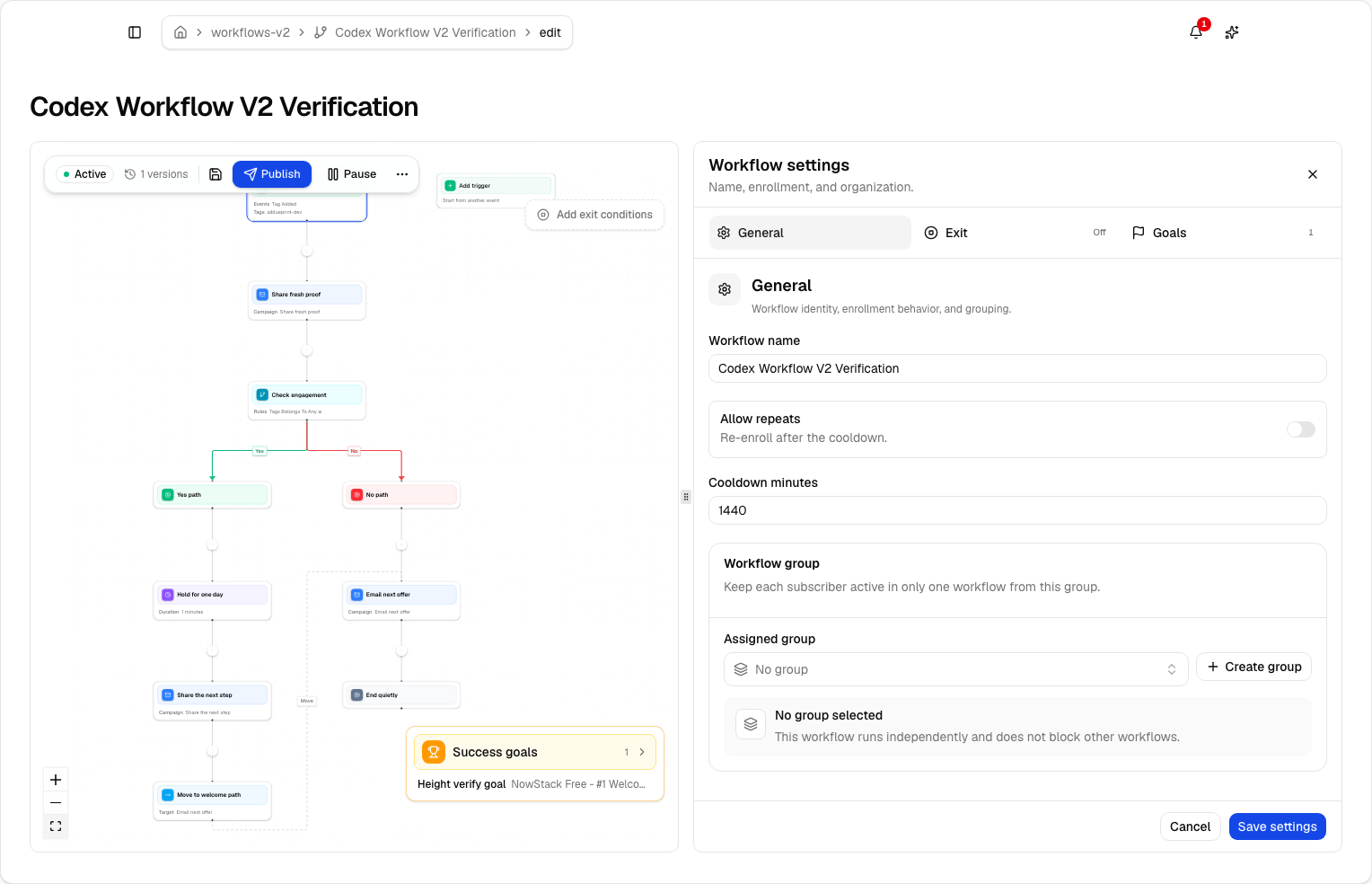
Lumail is an email platform that runs transactional email, campaigns, subscribers, and graph-based workflows in one organization. Your app sends through the REST API or the SMTP relay at smtp.lumail.io:587 with STARTTLS, and the same account handles the onboarding sequence and the monthly newsletter you would otherwise build on top of Mailgun. Agents can operate all of it through 89 organization-scoped MCP tools in ChatGPT, Claude, Claude Code, Cursor, and Codex, plus a CLI, a TypeScript SDK, and the REST API.
Pricing: Free is 3,000 emails a month with no credit card. Premium is $20 a month with 40,000 emails included, then $0.60 per 1,000. Business is $200 a month with 400,000 included, then $0.40 per 1,000. Subscribers are unlimited on every plan.
Choose it if:
- You maintain email code only because Mailgun has no journey builder, and would rather build sequences as visual graphs with triggers, waits, branches, goals, and exit rules
- You want marketing and transactional email on one bill, priced by volume
- You want AI agents to run campaigns and workflows, not only call a send endpoint
Watch out for:
- Lumail does not offer inbound routing or inbound parsing. If you rely on Mailgun routes to process replies or incoming mail, keep a provider that does (see the FAQ below).
- Lumail does not sell dedicated IP pools, which Mailgun offers on Scale.
See Lumail vs Mailgun side by side, or read the SMTP setup docs.
2. Amazon SES: best for the lowest cost per email
Amazon SES is AWS's pay-as-you-go email API and SMTP relay. It is the cheapest public rate in this list and handles outbound and inbound mail at very large scale. Nothing sits on top of it: no editor, no audience, no workflows.
Pricing: À la carte outbound is $0.10 per 1,000 emails with no monthly minimum, plus data charges. Newer accounts start on the Essentials plan at $0.16 per 1,000 for the first 10 million unless switched to à la carte. Dedicated IPs are $24.95 per IP per month.
Choose it if:
- Raw delivery cost matters more than anything else and you already run on AWS
- You want inbound handling through receipt rules to S3, SNS, or Lambda, or through Mail Manager
- Your team is comfortable owning IAM, quotas, and event pipelines
Watch out for:
- New accounts start in a sandbox and need AWS approval before production sending.
- Journeys, lists, and templates for marketing are yours to build and host.
See the full Lumail vs Amazon SES comparison.
3. Postmark: best for transactional deliverability
Postmark is ActiveCampaign's delivery service for application email. It keeps transactional and broadcast mail on separate Message Streams so one never drags down the other, and its inbound parsing posts incoming mail to your webhook as JSON.
Pricing: Free Developer is 100 emails a month. Basic is $15 for 10,000 emails, then $1.80 per 1,000; Pro is $16.50 ($1.30 per 1,000 extra); Platform is $18 ($1.20 per 1,000 extra). Inbound is on Pro and Platform.
Choose it if:
- Password resets and receipts are the whole job and inbox placement is the priority
- You want inbound mail parsed to JSON at a low plan price
- You value 45 days of full message history for support
Watch out for:
- No list uploads, WYSIWYG campaign editor, or campaign reporting, by Postmark's own description.
- There is no paid tier between 100 and 10,000 emails.
See the full Lumail vs Postmark comparison.
4. SendGrid: best for high volume with an optional marketing add-on
Twilio SendGrid is a high-volume Email API and SMTP relay, with a separately purchased Marketing Campaigns product for lists, single sends, and drip series. Its Email API includes an Inbound Parse webhook.
Pricing: Email API Essentials starts at $19.95 a month; Pro starts at $89.95 with a dedicated IP, subusers, and SSO. Marketing Campaigns starts at $15, and automation needs Advanced from $60.
Choose it if:
- You send at large scale and want dedicated IPs, subusers, and IP warmup
- You already use Twilio for SMS or voice
- You want marketers on a separate product while developers keep the API
Watch out for:
- Email API and Marketing Campaigns are two subscriptions, billed on different bases.
- The free option is a 60-day trial, not a permanent plan.
See the full Lumail vs SendGrid comparison.
5. Resend: best for developer experience
Resend is developer email infrastructure with SDKs, SMTP, inbound email, webhooks, and deliverability tooling, and it fits naturally with React Email. It also sells broadcasts and marketing contacts, on a separate plan.
Pricing: Free is 3,000 transactional emails or 1,000 marketing contacts. Paid starts at $20 a month for transactional and $40 a month for marketing.
Choose it if:
- API ergonomics and SDK quality are your main complaint about Mailgun
- You want inbound email on a modern developer platform
Watch out for:
- Transactional and marketing are separate plans, so receipts plus a newsletter means two subscriptions.
See the full Lumail vs Resend comparison.
6. SparkPost: best for deliverability analytics at scale
SparkPost, now sold as Bird Email, is a sending engine with REST and SMTP, Signals predictive analytics, and US and EU regions. Bird says the network carries about 40% of commercial email.
Pricing: Starter is $20 a month at the default 50,000-email volume. Premier is $75 a month at the same volume and adds a dedicated IP, automated IP warmup, A/B testing, 15 subaccounts, and inbound email webhooks.
Choose it if:
- You want health scores, spam-trap monitoring, and engagement insights on the base plan
- You need subaccounts and IP pools for multiple brands or clients
Watch out for:
- Inbound email is a Premier feature, not on Starter.
- The brand is mid-transition to Bird, so read which pricing grid you are looking at.
See the full Lumail vs SparkPost comparison.
7. MailerSend: best for small app volume with inbound routes
MailerSend is MailerLite's transactional product: REST API, SMTP relay, drag-and-drop templates, inbound routing, and optional US and Canada SMS, plus a hosted MCP server and CLI.
Pricing: Free is 500 emails a month after approval, with a card on file. Hobby is $7 for 5,000 emails, then $1.50 per 1,000. Starter is $35 for 50,000.
Choose it if:
- You send a few thousand app emails a month and want inbound routes at a low price
- Non-developers need to edit transactional templates visually
- You already run marketing on MailerLite
Watch out for:
- For newsletters and marketing automation, MailerSend points you to MailerLite, a separate product.
See the full Lumail vs MailerSend comparison.
How to choose a Mailgun alternative
- Inbound routes. If you parse incoming mail, shortlist only tools that receive it. From this list that means Amazon SES, Postmark (Pro and Platform), SendGrid, Resend, SparkPost (Premier), and MailerSend.
- Where sequences live. If your team maintains onboarding and newsletter logic in application code, a platform with built-in workflows removes that code. If sequences are rare, a pure API is fine.
- Volume shape. Per-1,000 overage rates matter more than the entry price once you pass the included allotment.
- Deliverability extras. Price dedicated IPs, validation, and inbox testing up front. Several vendors bill these separately.
- Agent and API access. Mailgun ships a local MCP server; check whether an alternative offers hosted or organization-scoped agent tools if AI agents will operate your email.
Worked example: 100,000 emails a month. A SaaS sending 100,000 emails a month (app notifications plus a weekly product update) would pay:
| Provider | Plan at 100,000 emails | Monthly cost |
|---|---|---|
| Amazon SES | À la carte | $10 plus data charges |
| Lumail | Premium, 60,000 over at $0.60 | $56 |
| MailerSend | Starter, 100,000 | $68 |
| Mailgun | Scale, 100,000 included | $90 |
| Postmark | Platform, 90,000 over at $1.20 | $126 |
| SendGrid, SparkPost | Volume-picker tiers | Check its pricing page for your tier |
Mailgun Scale also includes SSO, dedicated IP pools, and phone support, so compare features as well as totals.
How to migrate from Mailgun
- Export suppressions first. Pull bounces, unsubscribes, and complaints from Mailgun, plus any mailing-list members, and import them before you send anything from the new provider.
- Authenticate your sending domain. Add the new SPF, DKIM, and DMARC records alongside Mailgun's so both can send during the switch.
- Move one low-risk stream. Point a single transactional email, such as a login code, at the new API or SMTP host. On Lumail that is a credential and host change to
smtp.lumail.io:587. - Rebuild one sequence. Take the onboarding or welcome logic out of your code and rebuild it as a workflow, then send a test to a small internal segment.
- Cut over the rest, keep inbound where it works. Move remaining streams once delivery events look clean. If you depend on Mailgun routes and your new provider has no inbound, keep Mailgun for receiving only.
Frequently asked questions
What is the best free Mailgun alternative?
Lumail's free plan is 3,000 emails a month with no credit card, and Resend's free plan is 3,000 transactional emails. Both give far more room than Mailgun's 100 emails a day for a new product.
Is there a cheaper alternative to Mailgun?
Amazon SES is the cheapest on raw sending at $0.10 per 1,000 emails, if you can operate AWS. For an all-in-one platform, Lumail Premium is $20 for 40,000 emails, compared with Mailgun Basic at $15 for 10,000 plus overage from $1.80 per 1,000.
What is the best alternative to Mailgun inbound routes?
Lumail does not offer inbound routing, so it is not a replacement for Mailgun routes. Postmark parses inbound mail to JSON on its Pro and Platform plans, Amazon SES receives mail through receipt rules or Mail Manager, and SendGrid, Resend, MailerSend, and SparkPost Premier also handle inbound email.
What is the best Mailgun alternative for developers?
Resend if you care most about SDKs and React Email, Postmark if you care most about transactional deliverability, and Amazon SES if you want the lowest cost and already run on AWS.
Who are Mailgun's main competitors?
Mailgun's closest competitors are the other email APIs: SendGrid, Amazon SES, Postmark, SparkPost, Resend, and MailerSend. Platforms like Lumail compete when teams want campaigns and workflows alongside their app email.
Pick the one that matches your job
If Mailgun is only your sending pipe, another API with better pricing or inbound handling is the simplest switch. If you are maintaining newsletter and onboarding logic around it, start Lumail free and run one real sequence through it. For every head-to-head table, browse the comparison hub.