Best Resend Alternatives in 2026: 7 Tools Compared
Compare the best Resend alternatives for developers: one plan for marketing and transactional email, cheaper per-email APIs, and SaaS lifecycle tools.
In this guide
The best Resend alternatives are Lumail, Plunk, Loops, Postmark, Amazon SES, Mailgun, and MailerSend, depending on whether you need marketing and transactional email on one bill, the lowest possible cost per email, or a pure sending API with a different pricing curve. Resend is a strong developer product, so most teams switch because of how its plans are split, not because the API falls short.
We make Lumail, so it is listed first; every other entry is judged on the same criteria with facts from each vendor's pricing page as of August 2026.
Why people look for a Resend alternative
- Two plans for two kinds of email. Resend's free tier is 3,000 transactional emails or 1,000 marketing contacts, not one shared allowance. Paid plans start at $20/month for transactional and $40/month for marketing, so receipts plus a newsletter means two subscriptions.
- Marketing is priced by contacts. The marketing plan grows with stored contacts, while the transactional plan grows with sends. Two scaling axes are harder to forecast than one.
- Automation runs are metered. Paid plans include 10,000 automation runs, with usage overage after that.
- It is built for developers first. Resend offers broadcasts and contacts, but not a hosted newsletter publication. Teams where non-developers run campaigns often want a fuller visual editor and workflow canvas.
Resend alternatives at a glance
| Tool | Best for | Free plan | Paid from | Pricing basis |
|---|---|---|---|---|
| Lumail | Marketing and transactional email on one plan | 3,000 emails/month, no card | $20/month (40,000 emails) | Emails sent; unlimited subscribers |
| Plunk | Open-source, pay-per-email developer stack | 1,000 emails/month (hosted) | $0.001 per email, no base fee | Per email; unlimited contacts |
| Loops | SaaS lifecycle and product email | 1,000 contacts, 4,000 sends/month | $49/month (1,000–5,000 contacts) | Contact tier; unlimited sends on paid plans |
| Postmark | Transactional deliverability from code | 100 emails/month | $15/month (10,000 emails) | Monthly email volume |
| Amazon SES | Lowest cost per email on AWS | No standing free allotment; AWS credits | $0.10 per 1,000 emails | Per email, pay as you go |
| Mailgun | Inbound routing, validation, US/EU regions | 100 emails/day | $15/month (10,000 emails) | Monthly volume plus overage |
| MailerSend | Low-volume transactional with template builders | 500 emails/month, card required | $7/month (5,000 emails) | Monthly email volume |
| Resend | Developer-first transactional sending | 3,000 transactional or 1,000 marketing contacts | $20 transactional; $40 marketing | Separate transactional and contact plans |
1. Lumail: best for newsletters and transactional email on one plan
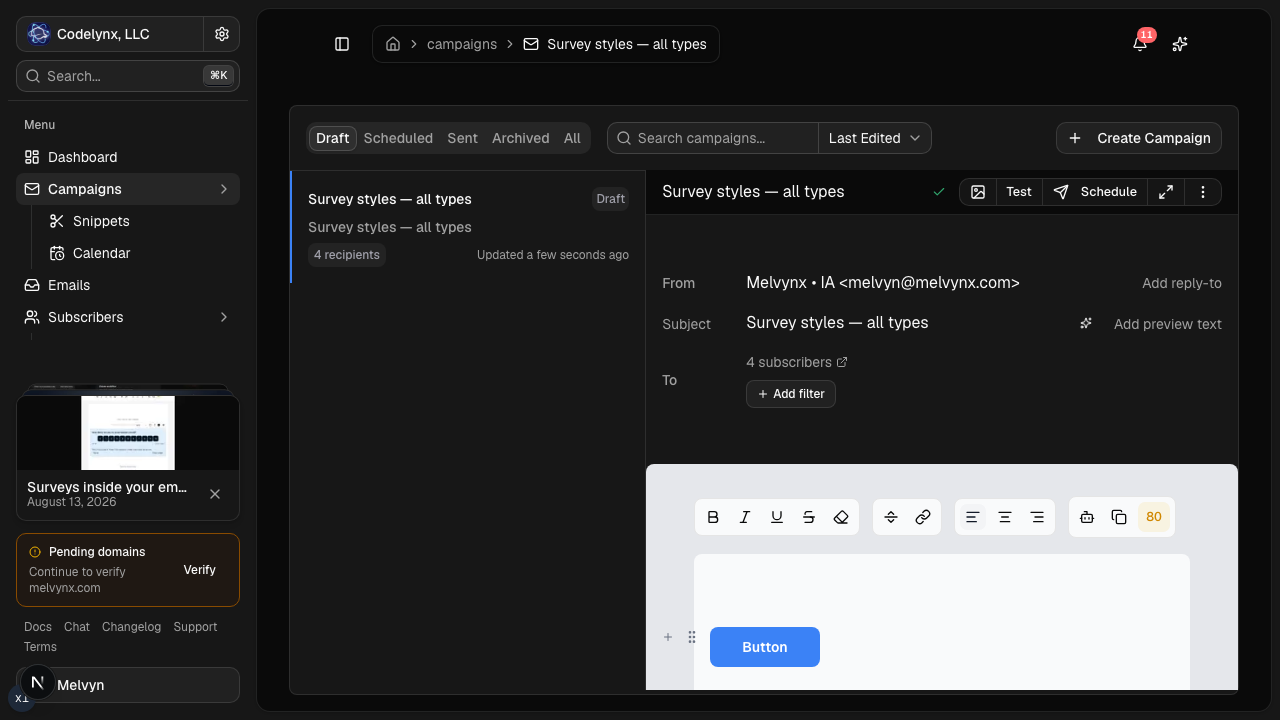
Lumail puts campaigns, graph workflows, subscribers, and transactional email in one organization. App email goes through the REST API or the SMTP relay at smtp.lumail.io:587 with STARTTLS, so moving off Resend is an endpoint and credential change rather than a rewrite. The marketing side is a full product: a visual editor, capture pages, and graph workflows with triggers, waits, conditions, branches, goals, exit rules, A/B paths, and webhooks. Agents get the whole platform through 89 organization-scoped MCP tools in ChatGPT, Claude, Claude Code, Cursor, and Codex, plus a CLI, TypeScript SDK, and REST API.
Pricing: Free is 3,000 emails/month with no credit card. Premium is $20/month with 40,000 emails included, then $0.60 per 1,000. Business is $200/month with 400,000 included, then $0.40 per 1,000. Subscribers are unlimited on every plan.
Choose it if:
- You send receipts and newsletters and want one allowance instead of a transactional plan plus a contact-priced marketing plan
- Non-developers need to edit campaigns and workflows without touching code
- You want an AI agent to operate subscribers, campaigns, workflows, and transactional sends
Watch out for:
- Lumail has no inbound email processing, which Resend offers
- It is not a website builder and has no hosted newsletter archive or paid subscriptions
See Lumail vs Resend side by side.
2. Plunk: best for open-source, pay-per-email sending
Plunk is an AGPL-3.0 email platform that combines transactional sending, campaigns, and graph workflows. You can use the hosted cloud or self-host it with Docker Compose on your own AWS SES account. It covers a REST API, SMTP, inbound email, and workflows in one contact record, and it markets itself as a way to stop splitting transactional and marketing tools.
Pricing: Hosted free is 1,000 emails/month, with a Plunk footer on marketing emails. After that it is $0.001 per email with no monthly base fee. Self-hosting has no Plunk per-email fee; you pay your own infrastructure and SES.
Choose it if:
- You want to self-host inspectable, open-source software
- Your volume is modest and pay-per-email beats any base fee
- You need inbound email, SMTP, and workflows in one developer tool
Watch out for:
- There is no official MCP server, ChatGPT plugin, or agent catalog; the official Node helper covers track and send only
- No capture or landing-page product is listed
See the full Lumail vs Plunk comparison.
3. Loops: best for SaaS lifecycle email
Loops is built for SaaS teams sending product and lifecycle email. It combines marketing broadcasts, event-driven loops, transactional email, and contact properties in a focused interface. If your audience is your product's user base and you email them often, its model is designed for you.
Pricing: Free covers 1,000 contacts and 4,000 sends/month. Paid starts at $49/month for 1,000–5,000 subscribed contacts, with unlimited sends and full features on paid plans.
Choose it if:
- SaaS lifecycle email is your main use case
- You email a known contact tier heavily, so unlimited sends pay off
- You prefer a polished product-email interface over a general platform
Watch out for:
- Price follows subscribed contacts, so a list that grows faster than your sending moves you up tiers
- The entry paid plan is $49/month, above Resend's $20 transactional entry
See the full Lumail vs Loops comparison.
4. Postmark: best for transactional deliverability
Postmark sends transactional and app-triggered broadcast email over a REST API and SMTP. It separates transactional and broadcast traffic into Message Streams so those reputations never mix. Pro and Platform plans parse inbound email into JSON webhooks, and it ships an official local MCP server with 24 tools plus a CLI.
Pricing: The free Developer plan is 100 emails/month. Basic is $15/month with 10,000 emails, then $1.80 per 1,000. Pro ($16.50) and Platform ($18) include the same 10,000 with lower overage rates.
Choose it if:
- Transactional email from code is the whole product you are buying
- You want stream-separated sending and deliverability-focused support
- You need inbound parsing on Pro or Platform
Watch out for:
- No journey builder, list uploads, or campaign reporting; sequences live in your application
- There is no paid tier between 100 and 10,000 emails/month
See the full Lumail vs Postmark comparison.
5. Amazon SES: best for the lowest cost per email
Amazon SES is AWS's pay-as-you-go sending API and SMTP relay. It answers the search for an email API "like Resend but cheaper," if you will build everything around the pipe yourself.
Pricing: À la carte outbound email is $0.10 per 1,000 with no monthly minimum. New accounts default to the Essentials plan (from $0.16 per 1,000) unless switched. There is no standing SES-only free allotment; new AWS customers can get up to $200 in Free Tier credits.
Choose it if:
- Raw delivery cost dominates every other factor
- You already build on AWS and only need API, SMTP, and events
- You need inbound processing, archiving, or dedicated IPs
Watch out for:
- There is no editor, audience management, or workflow builder
- New accounts start in a sandbox: 200 messages per 24 hours to verified recipients only
See the full Lumail vs Amazon SES comparison.
6. Mailgun: best for inbound routing and EU data residency
Mailgun, part of Sinch, is a delivery service for sending, receiving, and tracking application email. It offers US and EU regions, inbound routes, email validation, webhooks, and dedicated IPs, plus an official local MCP server documenting 50+ operations.
Pricing: Free Send includes 100 emails/day. Basic starts at $15/month for 10,000 emails, with extras from $1.80 per 1,000. Foundation is $35/month for 50,000 and Scale is $90/month for 100,000.
Choose it if:
- You need inbound parsing and EU region endpoints
- You want dedicated IP pools or validation from the same vendor
- Your lists already live in your own app
Watch out for:
- No visual journey builder; sequences are application-triggered
- Optimize and Inspect are separate products with separate bills
See the full Lumail vs Mailgun comparison.
7. MailerSend: best for low-volume transactional with template builders
MailerSend is MailerLite's transactional product: REST API, SMTP relay, drag-and-drop and HTML template builders, inbound routing, and optional US/Canada SMS. It also runs a hosted MCP server with 127 named tools and a CLI, focused on sending, domains, templates, and suppressions.
Pricing: Free is 500 emails/month after account approval, with a credit card required but not charged. Hobby is $7/month for 5,000 emails, then $1.50 per 1,000. Starter starts at $35/month for 50,000.
Choose it if:
- You send a few thousand app emails a month and want a $7 plan
- Non-developers need to edit transactional templates visually
- You need US/Canada transactional SMS
Watch out for:
- MailerSend's own help sends newsletters and marketing to MailerLite, a separate product
- The free plan pauses sending at its cap instead of billing overage
See the full Lumail vs MailerSend comparison.
How to choose a Resend alternative
- Count your email streams. If you only send transactional mail, Postmark, Mailgun, MailerSend, or SES compete directly with Resend's transactional plan. If you also send newsletters, compare one allowance (Lumail, Plunk) against two plans.
- Match the pricing basis to your list. Contact-priced tools (Resend marketing, Loops) favor small lists you email often. Per-email tools (Plunk, SES) favor low volume. Included-volume plans (Lumail, Postmark, Mailgun, MailerSend) favor steady monthly sending.
- Decide who edits email. If only developers touch templates, an API is enough. If marketers ship campaigns weekly, you need a visual editor and workflow canvas.
- Check agent and developer access. Lumail exposes the whole platform through 89 organization-scoped MCP tools. MailerSend, Postmark, and Mailgun offer MCP servers focused on sending operations. Plunk has no official one.
- Check inbound email. Resend, Plunk, Postmark (Pro and Platform), Mailgun, and MailerSend handle inbound mail. Lumail does not.
Worked example. A SaaS team with 8,000 subscribers sends two product newsletters a month (16,000 emails) plus 6,000 transactional emails, so 22,000 emails total.
- Lumail: fits inside Premium's 40,000 included emails, so $20/month.
- Plunk hosted: 22,000 × $0.001 = $22/month.
- Amazon SES à la carte: 22,000 at $0.10 per 1,000 = $2.20 plus data charges, before you build the editor, lists, and workflows.
- Postmark Basic: $15 + 12,000 extra at $1.80 per 1,000 = $36.60, and newsletters still go out from your own code.
- Resend: a transactional plan from $20 plus a marketing plan from $40, so at least $60 across two plans. Check its pricing page for the contact tier 8,000 contacts lands in.
How to migrate from Resend
- Export marketing contacts with their state. Bring unsubscribes and bounces, not only active contacts, so suppressions carry over.
- Authenticate your sending domain. Add SPF and DKIM for the new provider and keep Resend live while DNS propagates.
- Re-point transactional sends. Swap the API endpoint or SMTP credentials (for Lumail, see the SMTP guide) and send a test for every template before cutting over.
- Rebuild your most important automation. Recreate it as a workflow with explicit waits and exits, and run a test subscriber through each path.
- Send one broadcast to a small segment, then move the rest. Check rendering, links, and unsubscribe behavior before scheduling to the full list. Some teams keep part of their transactional path on Resend during the transition.
Frequently asked questions
Is there a cheaper email API for developers like Resend?
Amazon SES is the cheapest per email at $0.10 per 1,000 à la carte, but you build everything else yourself. Plunk charges $0.001 per email with no base fee, and MailerSend's Hobby plan is $7/month for 5,000 emails. If you send both transactional and marketing email, Lumail covers both on one $20 plan with 40,000 emails.
Does Resend have contact list and audience management features built in?
Yes. Resend offers contacts, broadcasts, and automations, but they sit on a separate marketing plan priced by contacts, with 1,000 marketing contacts on the free tier and paid marketing plans from $40/month. It is not a hosted newsletter publication.
How much does Resend cost?
Resend's free tier is 3,000 transactional emails or 1,000 marketing contacts. Paid plans start at $20/month for transactional email and $40/month for marketing, and paid plans include 10,000 automation runs with usage overage after that.
What is the best free Resend alternative?
Lumail's free plan includes 3,000 emails/month for both transactional and marketing email, with no credit card and unlimited subscribers. Loops offers 1,000 contacts and 4,000 sends/month free, and Plunk offers 1,000 hosted emails/month or free self-hosting.
What is the best Resend alternative for newsletters?
Lumail, because newsletters, graph workflows, capture pages, and transactional email share one organization and one volume-based plan. Loops is a good fit if the newsletter is really SaaS lifecycle email to your product's users.
Pick the model, then the vendor
Resend is excellent when email is infrastructure your developers own. Among Resend alternatives, Lumail fits teams that want receipts, newsletters, and workflows on one plan their agents can also operate: start Lumail free with 3,000 emails per month and no credit card. Or browse the email platform comparison hub.